Confederates at Redtwist


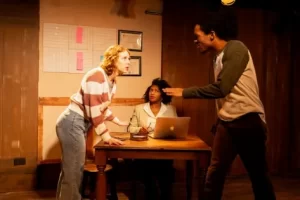
Madelyn Loehr (Candice), Monique Marshaun (Sandra) and Makari Tobinson-McNeese (Malik) Photo by A.R. Boseman

Highly Recommend

Be prepared – – I am getting ready to gush because this production of Confederates by playwright Dominique Morrisseau and directed by Aaron Reese-Boseman at Redtwist Theater is the level of writing and performance I hope to see when attending a play.

This intimate drama delivers a message of unconscious bias and institutional slavery put into motion generations ago but still very much alive and grappled with today on both sides of the racial divide.

Sandra (Monique Marshaun) a female African American social science professor at a predominantly white university has been racially targeted through the appearence of an image of her face “photoshopped” on to the body of an enslaved wet nurse with a white baby at her breast.

The message seems to suggest that Sandra shows favoritism toward white students over her black students and is doing so perhaps as a way to maintain her own status as the most senior woman of color in her department.

The image has caused great distress to Sandra resulting in frank and sometimes too honest discussions between her, her students and her colleagues as she endeavors to discover the person or persons behind the perceived slander.

Alternately, the action shifts to the life of enslaved woman Sara (Shenise Danyel) whose brother Abner (Makari Robinson-McNeese) has escaped the plantation toward the end of the American Civil War, and taken up arms with the Union Army.

Sara also wants her freedom but is hesitant to take action. In the meantime, her master’s daughter, Missy Sue, claims to have been enlightened through visits to the North where she has come in contact with abolitionists.

Madelyn Loehr (Candice), Monique Marshaun (Sandra) and Makari Tobinson-McNeese (Malik)

She claims to have always loved Sara who was her companion and confident as a child and wants her to join in a scheme to transfer information about Confederate troop movements through Abner to the Union Army. Sara doesn’t know who to trust and what to do.

Time shifting within a story can be quite challenging but this Redtwist company under the direction of Aaron Reese manages it seamlessly. It includes some necessary adjustments to the clever set design of Kevin M. Rolfs.

The costumes by Marquecia Jordan are well considered but Missy Sue’s late 18th Century traveling dress is a standout.

Sandra and Sara stay within their own time periods while McNeese as Abner also plays university student Malik. Likewise, Loehr has the roles of Missy Sue and student Candice while Tocarra Castleman plays the enslaved LuAnne and University Instructor Jade.

Each of these actors morph effortlessly between their roles including a number of quick costume changes and substantial linguistic shifts in dialect that appears almost like a magic act.

Sandra and Sara face their own existential dangers as they confront the challenges of their white male dominated societies while simply trying to improve their lives and advance their positions.

The expert handling of this somewhat complex storyline along with the requisite dialog in both academic and historic vernacular is superb. Each of these actors have literally consumed their roles performing the material with total believability, naturalness and nuance. This is the style of acting that I yearn for and unfortunately find missing in many productions today.

I am reluctant to speak about any individual actor as they each without equivocation equally contribute to the success of the whole. This is a masterclass in acting. Any young performer looking for inspiration should rush to see this.

How is it that this superb production is hiding away in a thirty-seat storefront theater in Edgewater? Someone needs to gather up this show with this company and put them in a bigger venue with a larger audience. Both the performers and the story deserve to be seen and heard.

This goes to demonstrate that you do not need massive budgets or star power to create great theater. There is simply no substitute for good writing and insightful performance.

Redtwist is a not-for-profit enterprise that deserves your support as an audience member and/or as a philanthropic contributor.

Confederates is at Redtwist Theater, 1044 W. Bryn Mawr, Chicago through March 8, 2026. Runtime is 90 minutes with no intermission. Visit redtwisttheatre.org for tickets and information.

Reviewer Reno Lovison

For more shows and reviews visit Theatre in Chicago

Admissions

Highly recommended

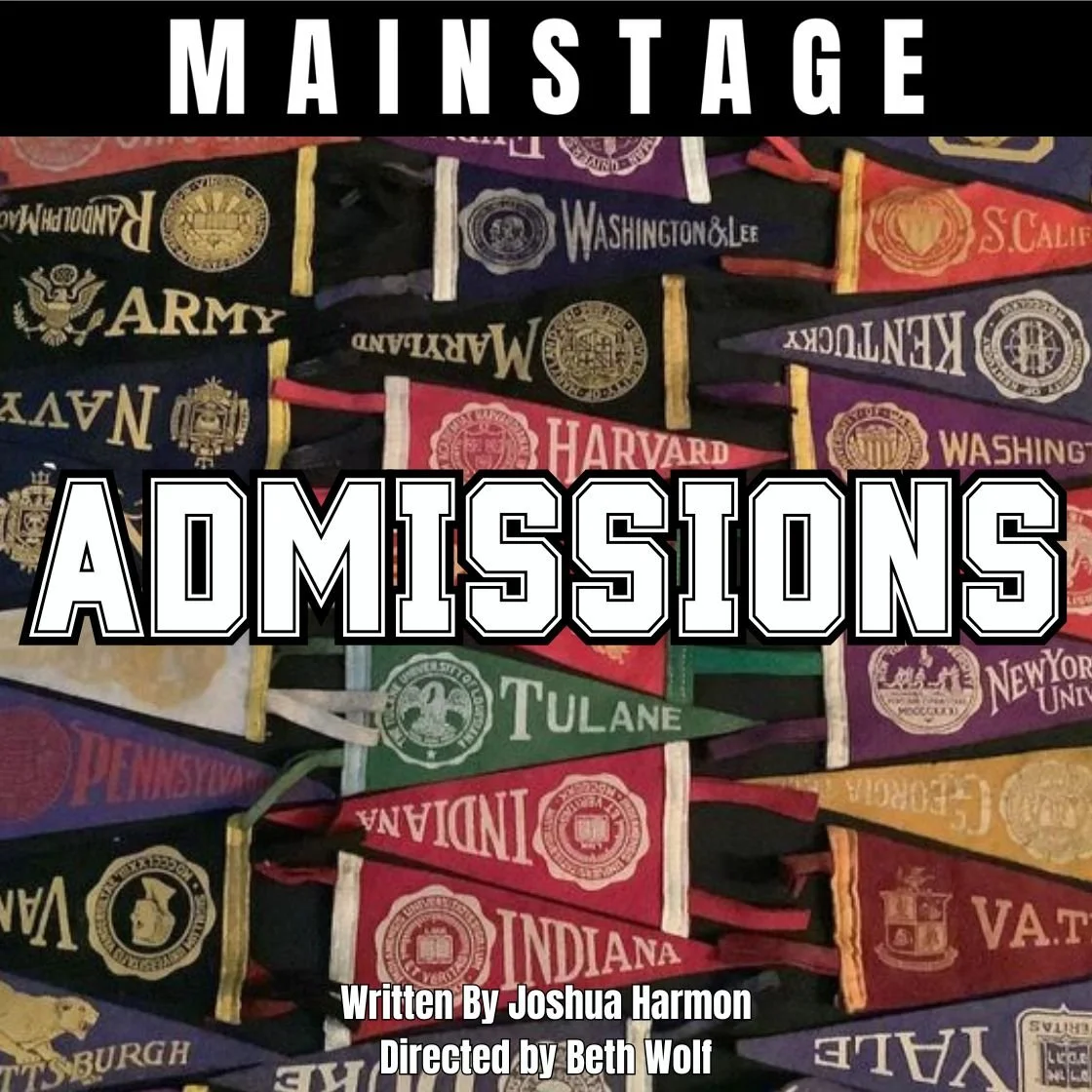
“Admissions,” a play by Joshua Harmon now at Citadel Theatre, should have its audiences talking about who, how and why a graduating high schooler is readily admitted to the college of choice.

Bright high school student Charlie Luther Mason, superbly interpreted by Justin Jarzomek, is applying to college. He has the grades and activities needed to supposedly get into many prestigious Eastern universities. That is not the problem.

We learn that his friend who wrote “black” on his application because his dad is black, gets into Yale but Charlie is on the school’s deferred list.

Ginnie Peters (Tina Shelley) his friend’s mom, is white and a good friend of  Charlie’s mom, Sheri Rosen-Mason (Susie Steinmeyer), at least when the play begins.

Spoiler alert: Charlie is admitted to a prestigious university by the play’s end but but thinks he shouldn’t go because he is supposedly taking up a spot for a less advantaged student.

How he arrives at that kind of thinking is really what this this play is all about. That, and the attitude of Charlie’s mom Sheri, a college admissions  administrator (not clear if she works for the high school) and his dad, Bill Mason (Tim Walsh) offer the play’s philosophical bent.

Directed by Beth Wolf, the play should spark some interesting conversations.

Admissions is at Citadel Theatre, 825 Waukegan Rd. Lake Forest, Il now through March 15, 2026.

Jodie Jacobs

For more reviews visit Theatre in Chicago


Death dances at Steppenwolf


Jeff Perry and Kathryn Erbe in “Dance of Death” at Steppenwolf

Somewhat Recommended

The highlight of Dance of Death at Steppenwolf is the outstanding set design of Collette Pollard, that dominates the stage.

Featuring an impressive, ancient, oppressive, dimly lit three story plaster and brick edifice, that apparently was a former jail, it is now the military home of a company commander and his wife located on an offshore island.

Set in Scandinavia sometime in the late 19th or early 20th Century, Alice (Kathryn Erbe) and Edgar (Jeff Perry) will soon be marking the 25TH anniversary of their mostly unhappy marriage. The structure serves as a physical representation of the couple’s own feelings of entrapment and isolation.

The two are alienated from their community, their extended family, their teenaged children (away at boarding school) and most importantly from each other.

Edgar is an aging soldier who only feels alive when there is conflict in his life, while Alice a former actress requires constant drama.

Their relationship was founded on mutual physical attraction that has generally faded with time and has never matured or progressed to one of mutual understanding and companionship, consequently the two alpha types battle to maintain their dominance over one another and retain the illusion of their own youthful personas.

The arrival of an old friend Kurt (Cliff Chamberlain) offers an opportunity for distraction as each try to engage him as an ally, but ultimately, they treat him more like a mouse that has wandered in and is unable to find his way out, becoming simultaneously an object of amusement, intrusion and torment.

Since I am unfamiliar with the original version by August Strindberg, I am not sure how this new version by Conor McPherson compares. I can’t exactly identify why the dialog seems uncomfortable but it seems like it has one foot on the platform and the other on the train. The cadence was odd and theatrical, never sounding truly authentic.

Ultimately this is a rather simplistic storyline that is a voyeuristic expose of a dysfunctional relationship. The imposing set and time period makes it feel like a classic opera without the satisfaction of some beautiful music or any soaring highs and lows. This never reaches the dramatic level of similar plays like Hedda Gabbler, Little Foxes, or Who’s Afraid of Virginia Woolf.

Veteran actor and Steppenwolf cofounder Jeff Perry is obviously at home on this stage. His physicality and slightly over-the-top performance belies his fifty-year association with the renowned theater company.

Erbe found her stride in the second act, however Chamberlain seemed to never fully strike the right tone for me. To some degree this was likely due to the challenge of playing a shy person while still maintaining a commanding stage presence. Also, his character is written in such a way that he is full of unresolved backstory that comes across as a fragment from another play.

Perry used the whole stage and made his character large. Erbe and Chamberlain often appeared to be unsure exactly where they should be, moving tentatively if at all.

The costume choices for the captain by Ana Kuzmanic, and the lighting of Lee Fiskness including the in-floor lights and outside ambient lighting were very effective.

It is assumed that movement consultant Claire Kaplan is at least in part responsible for the captain’s very entertaining solo dance performance.

A story of narcissistic marital conflict, it is not all doom and gloom. There is plenty of tension and vengeful plotting but also moments of dark humor and at least a momentary truce or two.

This had some good moments. The set design is awesome but the dialog seems stilted, it’s a bit long, and the play overall is just not as satisfying as I had hoped.

Details: Dance of Death at Steppenwolf, 1650 N. Halsted Street, Chicago, through March 22, 2026. Runtime about 2 and a half hours with one intermission. For tickets visit Steppenwolf.org or call (312)335-1650.

For more reviews visit Theatre in Chicago

Reno Lovison

Dance of Death Steppenwolf

The Dance of Death 16. Photo by Michael Brosilow

Jerry Perry and Kathryn Erbe in “Dance of Death” at Steppenwolf

Somewhat Recommended

The highlight of Dance of Death at Steppenwolf is the outstanding set design of Collette Pollard, that dominates the stage.

Featuring an impressive, ancient, oppressive, dimly lit three story plaster and brick edifice, that apparently was a former jail, it is now the military home of a company commander and his wife located on an offshore island.

Set in Scandinavia sometime in the late 19th or early 20th Century, Alice (Kathryn Erbe) and Edgar (Jerry Perry) will soon be marking the 25TH anniversary of their mostly unhappy marriage. The structure serves as a physical representation of the couple’s own feelings of entrapment and isolation.

The two are alienated from their community, their extended family, their teenaged children (away at boarding school) and most importantly from each other.

Edgar is an aging soldier who only feels alive when there is conflict in his life, while Alice a former actress requires constant drama.

Their relationship was founded on mutual physical attraction that has generally faded with time and has never matured or progressed to one of mutual understanding and companionship, consequently the two alpha types battle to maintain their dominance over one another and retain the illusion of their own youthful personas.

The arrival of an old friend Kurt (Cliff Chamberlain) offers an opportunity for distraction as each try to engage him as an ally, but ultimately, they treat him more like a mouse that has wandered in and is unable to find his way out, becoming simultaneously an object of amusement, intrusion and torment.

Since I am unfamiliar with the original version by August Strindberg, I am not sure how this new version by Conor McPherson compares. I can’t exactly identify why the dialog seems uncomfortable but it seems like it has one foot on the platform and the other on the train. The cadence was odd and theatrical, never sounding truly authentic.

Ultimately this is a rather simplistic storyline that is a voyeuristic expose of a dysfunctional relationship. The imposing set and time period makes it feel like a classic opera without the satisfaction of some beautiful music or any soaring highs and lows. This never reaches the dramatic level of similar plays like Hedda Gabbler, Little Foxes, or Who’s Afraid of Virginia Woolf.

Veteran actor and Steppenwolf cofounder Jeff Perry is obviously at home on this stage. His physicality and slightly over-the-top performance belies his fifty-year association with the renowned theater company.

Erbe found her stride in the second act, however Chamberlain seemed to never fully strike the right tone for me. To some degree this was likely due to the challenge of playing a shy person while still maintaining a commanding stage presence. Also, his character is written in such a way that he is full of unresolved backstory that comes across as a fragment from another play.

Perry used the whole stage and made his character large. Erbe and Chamberlain often appeared to be unsure exactly where they should be, moving tentatively if at all.

The costume choices for the captain by Ana Kuzmanic, and the lighting of Lee Fiskness including the in-floor lights and outside ambient lighting were very effective.

It is assumed that movement consultant Claire Kaplan is at least in part responsible for the captain’s very entertaining solo dance performance.

A story of narcissistic marital conflict, it is not all doom and gloom. There is plenty of tension and vengeful plotting but also moments of dark humor and at least a momentary truce or two.

This had some good moments. The set design is awesome but the dialog seems stilted, it’s a bit long, and the play overall is just not as satisfying as I had hoped.

Details: Dance of Death at Steppenwolf, 1650 N. Halsted Street, Chicago, through March 22, 2026. Run-time about 2 and a half hours with one intermission. For tickets visit Steppenwolf.org or call (312)335-1650.

For more reviews visit Theatre in Chicago

Reno Lovison

For Love and Money

(L-R) Molly Griggs, Wesley Taylor, Bryce Gangel, Luigi Sottile, Jordan Lage.(Photo by Todd Rosenberg)

Highly Recommended

For Love and Money

“Holiday” at The Goodman is a fresh world-premiere adaptation of the classic boy meets girl – – boy meets girl’s sister. A romcom by Richard Greenberg, it is based on the original 1928 version by playwright Philip Barry and features an outstanding cast.

A drawing room drama in two acts, it takes place in the opulent uptown home of Edward Seton III (Jordan Lange) an extremely wealthy New York banker. His wife has died and he is the patriarch of an old money family with three adult children.

This is a story about familial love, romantic love and sexual attraction as well as the influence of money, and in both cases  those who have too much, those who do not have enough, and those who want more.

Idealistic up-and-coming young attorney Johnny Case (Luigi Sottile) recently met Julia Seton (Molly Griggs) at a New-Age retreat where they spent some extended time together, fell in love and impulsively became engaged.

Julia is a driven entrepreneur owner of a boutique fashion line who neglected to tell Johnny about the fact that she is associated with this extremely wealthy family. This is a fact Johnny has to come-to-terms with just as father Edward has to consider whether this new fiancé is actually a gold-digger.

Julia’s siblings include her substance abusing brother Ned a/k/a Edward Seton IV (Wesley Taylor) who is the primary reason alcohol is not allowed in the house except during holidays. This is apparently from where the play’s name is derived. Their sister Linda Seton (Bryce Gangel) is an artist who lives in Brooklyn where she also works with children.

Linda is torn between two worlds which keeps her at odds with her father who feels rejected by her lifestyle choices. She loves Julia, though she feels the aging debutante is shallow and too dependent on her wealth.

Both sisters are protective of brother Ned though Julia wants to fix him while Linda wants to nurture him back to health. Of course, Edward feels Ned simply needs to stop his nonsense and apply himself to his work.

Drunk roles can be difficult and cringy but Taylor performs Ned with sympathetic perfection achieving a delicate balance of a person teetering on the edge of destruction with just enough control to keep him from being obnoxious or comical.

Disconnected from reality and inhibition Ned is the one most able to see and speak the truth around them. This makes him something of a fool or a shaman. In a desperate need for insight and understanding of her own feelings, Linda asks him to describe in detail what he experiences in his drunken stupor as she considers whether she wants to go there – – either to escape or find answers.

Ultimately this is a love triangle that forces each member of the triumvirate to consider what kind of life they really want.  It’s like a road trip where you know the destination but how you get there is the fun part. At one point the sexual tension was so great that when it was released the audience audibly responded.

The dialogue is real and the adaptation by Greenberg deftly introduces modern elements such as cellphones, the Internet, Uber versus Lyft, Instagram, and Door Dash as well as other linguistic transformations and social evolutions that did not exist in 1928. On the contrary what is amazing is how little has actually changed in the way of social interaction and societal relationship to love and money.

Directed by Robert Falls, the pacing was impeccable. The first act seemed to fly by. I was so engaged in the action that I was actually astounded when it had concluded, after a very typical one hour.

The set design of Walt Spangler was spectacular. As the curtain opened revealing the understated grandiose interior of the Seton Family residence with the particularly well rendered portrait of founding progenitor Edward Seton the first, it was obvious we were in for an interesting story.

Costumes by Kaye Voyce included an ensemble of boho chic for Linda and more sophisticated dresses for Julia while Ned lounged around in essentially the same mismatched jog pants and rumpled shirt, indicating he probably never changed his clothes.

Voyce probably had the most fun with the nearly outlandish attire of Laura and Seton Cram (Alejandra Escalante, Erik Hellman) two over-the-top cousins who arrive for lunch from Palm Beach and later help to fill out the all-important Holiday party.

Walter (Rammel Chan) is the long suffering household cook responsible for catering the luncheon and Holiday dinner.

Other guests include the caftan clad Nikka Washburn (Christiana Clark) and Susan Feld (Jesse Fisher) presented in this adaptation as an interracial lesbian couple where Feld incidentally is Jewish as well, so Greenberg covers a lot of territory with these two.

It turns out that both Johnny and Linda are acquainted with Washburn and Feld which becomes a literal point of connection between them. The couple represent everything that the Setons are not.

Before attending I asked myself why is Goodman reviving this 100-year-old play and why now? Well, it is the 100th Anniversary of The Goodman and in short except for the wrapper it seems interpersonal relationships have not changed much.

I may be a bit old fashioned but this production is the gold standard of everything I feel traditional theater should be. In this era of obligatory standing ovations this very appreciative audience leapt to their feet in unison at the conclusion of the performance.

Details: Holiday is at The Goodman – Albert Theatre 170 N Dearborn, Chicago through March 1, 2026. For tickets and information call (312)443-3800 or visit goodmantheatre.org.

Reviewer: Reno Lovison

Spring at the Garden

Orchids go on sale. (J Jacobs photo)
(J Jacobs photo)

The calendar says it’s February which translates to flowers for Valentine’s Day. But let’s go longer and bigger in 2026 and think Feb. 7 to March 22. That is how long gorgeous orchids take over the Chicago Botanic Garden’s greenhouses.

Just don’t be surprised to find the more than 10,000 orchids are expressing their beauty via a flower-filled Volkswagen Beetle on Rt. 66, hanging drapery and even a lava lamp.

That’s because the folks (including volunteers) at the Botanic Garden have turned the years back to the 1960s and ’70’s for this year’s Orchid Show theme: ” Feelin’ Groovy.”

The Chicago Botanic Garden is  at 1000 Lake Cook Rd., Glencoe.

The Orchid Show | Chicago Botanic Garden

Jodie Jaccobs


You are in good Company


Recommended

Enjoyable and entertaining with a distinct mid-century vibe. Stephen Sondheim’s vintage musical “Company” presented by Madkap Productions explores the life choices of Bobby (Graham Todd) the only one of his friends still unmarried at a time when marriage by thirty was expected.

The five couples in Bobby’s life are seemingly satisfied in their pairing. Each of the men are a bit envious of his “freedom,” while each of the women feel he must be sad, lonely and in need of a partner.

Bobby is in fact apparently satisfied with his situation and the array of choices he has within his dating life. He’s curious to know why his friends are so anxious for him to find a mate – – is it simply a matter of companionship?

“Company” as in companionship is the theme. The company of each couple as well as the company Bobby keeps with each of them and the larger group. Graham Todd as Bobby brings the requisite boyish charm and excellent vocal capability to the role.

Directed by Steve Scott, the show is presented as a series of vignettes, where Bobby explores this question and each couple explores him. It is performed in a near cabaret style with minimal staging, perfect for the intimate confines of the Skokie Theatre. The choreography of CeCe Lampa is compact and harkens back to the period. As always, the music direction and orchestration of Jeremy Ramey with his small ensemble is exceptionally well done.

First produced in 1970 and still at the relatively early part of his career, the sound of each song is classic Sondheim with complicated rhythms and snappy clever lyrics. You can hear the experimentation that will mature in later works like “Sweeney Todd, Sunday in the Park with George and Into the Woods.” A few standout numbers here include “Another Hundred people performed by Anna Seibert (Marta); “Ladies Who Lunch” performed by Rena Ahmed (Joanne) and of course “Being Alive” sung by Bobby. In “I’m Not Getting Married Today” Jamie Todd (Amy) nearly has a complete, somewhat comical though painful to watch, mental breakdown.

Ultimately the message here is that life and relationships are messy. Connection requires intimacy and vulnerability and being alive requires a willingness to live with imperfection.

Details: Company is presented by Madkap Productions at the Skokie Theatre, 7924 Lincoln Ave., Skokie through March 1, 2026, tickets can be purchased online at SkokieTheatre.org or by calling 847-677-7761.

Note: MadKap is celebrating its 11th year at Skokie Theatre and is the recipient of the 2019 Artistic Excellence award from the Village of Skokie Fine Arts Commission.

By Reno Lovison

Country Music Awards


2026 Grammy Awards (Country)

It was a lively crowd at the CMA award ceremony Sunday.

Unlike earlier award shows this year where the audience pretty much clapped from their seats, the Country Music Awards crowd often stood and even participated during the song presentations.

Up against  such stars as Tyler Childers, “Nose On the Grindstone” and Shaboozey, “Good News,” Zach Top, “I Never Lie” and Lainey Wilson, “Somewhere Over Laredo,” it was Chris Stapleton, “Bad As I Used To Be” (From F1 The Movie) who won Best Solo Performance Sunday.

It was a night of stars where even some took the stage for comments such as Reba McEntire, who along with Miranda Lambert and Lainey Wilson, did not win for their “Trailblazer” but McEntire led the In Memoriam to fallen music industry greats and her son.

Jodie Jacobs

Read More: 2026 Grammy Awards: Full List of Country Music Winners 

last Minute Getaways

WF25_1st Place_Sculptora Borealis_WI3

Block #7 | Wisconsin 3 | Sculptora Borealis | “Creativity Come to Life”


February is already around the corner so don’t be surprised if there are a few last minute day or overnight trips we almost overlooked. But they still can be slivered into the schedule.

1. Lake Geneva Winterfest

The weather looks fine this weekend for driving up to Lake Geneva, WIfor its Winterfest. Sponsored by Discover Wisconsin, this annual celebration of snow creativity is going on right now north of Chicago.

Teams of snow sculptors have invaded Lake Geneva this week-weekend with their creative concepts of what can be done with snow and hand tools. They have been working on their creations at Riviera Plaza and Flat Iron Park since their blocs of snow were delivered on Wednesday. 

These art works will be up through Sunday or until they melt. However, the judging and awards are done today, Jan. 31, 2026. 

In addition, the town is hosting its Downtown Ice Sculpture WalkBonfires on the Beach and entertainment.


Groundhog Dy in Woodstock. (JJacobs photo)

J  Jacobs image

2. Groundhog Day in Woodstock, IL

Producer Harold Ramis’ famed movie that supposedly takes place in Pennsylvania but is actually shot in Woodstock, IL, centers around a groundhog’s winter-spring prediction.

It’s fun to see the movie and its noted filmed spots up in Woodstock, a town northwest of Chicago.

Celebrated this year in Woodstock with a recreation of Woodstock Willy’s prediction Feb. 2, many of the activities are really going on right now so don’t worry if you can’t drive up there for the actual announcement.

The “live” set is a fun place to visit.

Jodie Jacobs


Here now and soon

Le Sud Mediterranean Kitchen

(Le Sud Mediteranean) photo

First, Chicago Restaurant Week, which is longer than 7 days, is welcoming diners to more than 500 eateries and bars with special prices now through Feb. 28, 2026.

This is a good chance to try that restaurant you’ve heard or read about.


Rosa

(Photo courtesy of Chicago Botanic Garden)

So glad February  means the Orchid Show is here.

OK, so the tulips are not yet pushing through the soil in the Midwest. But there are spring-like activities north in Glencoe to warm or at least brighten the still chilly temps.

The Chicago Botanic Garden’s Orchid Show is now on the calendar. So don your old bell-bottoms (or at least wide pants legs) because the show pays homage to a long-ago, fun decade.

Called “Feeling Groovy,” subtitled “Let the Sunshine in,”  the show runs 10 a.m.-4 p.m. Feb. 7 to March 22, 2026.

Chicago Botanic Garden is at 1000 Lake Cook Rd, Glencoe, (bordering Highland Park  and Edens Hwy)


Third and no way least is the Chicago Auto Show

The Chicago Auto Show will be at McCormick Place Feb. 7-Feb 16.

Find test drives, new cars and other information at Auto show.


And get off that couch or away from that desk to try some of these events before they disappear with calendar page changes.

Jodie Jacobs