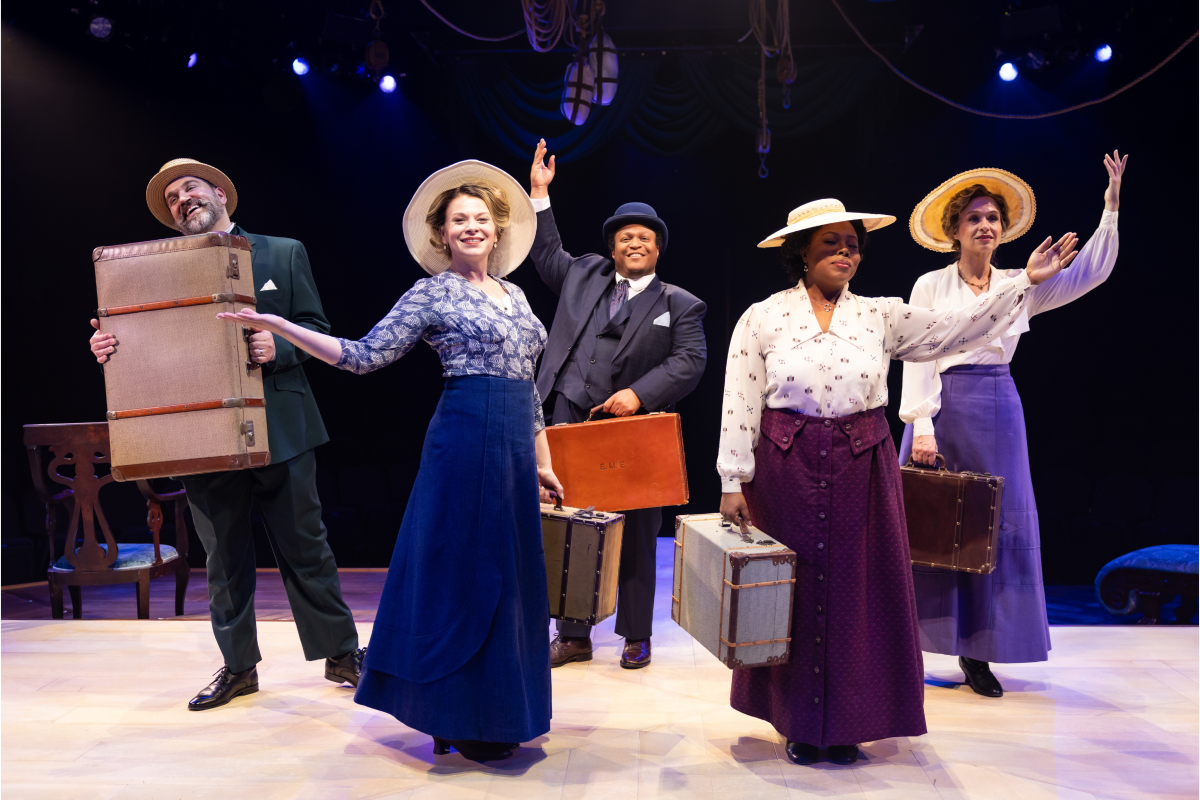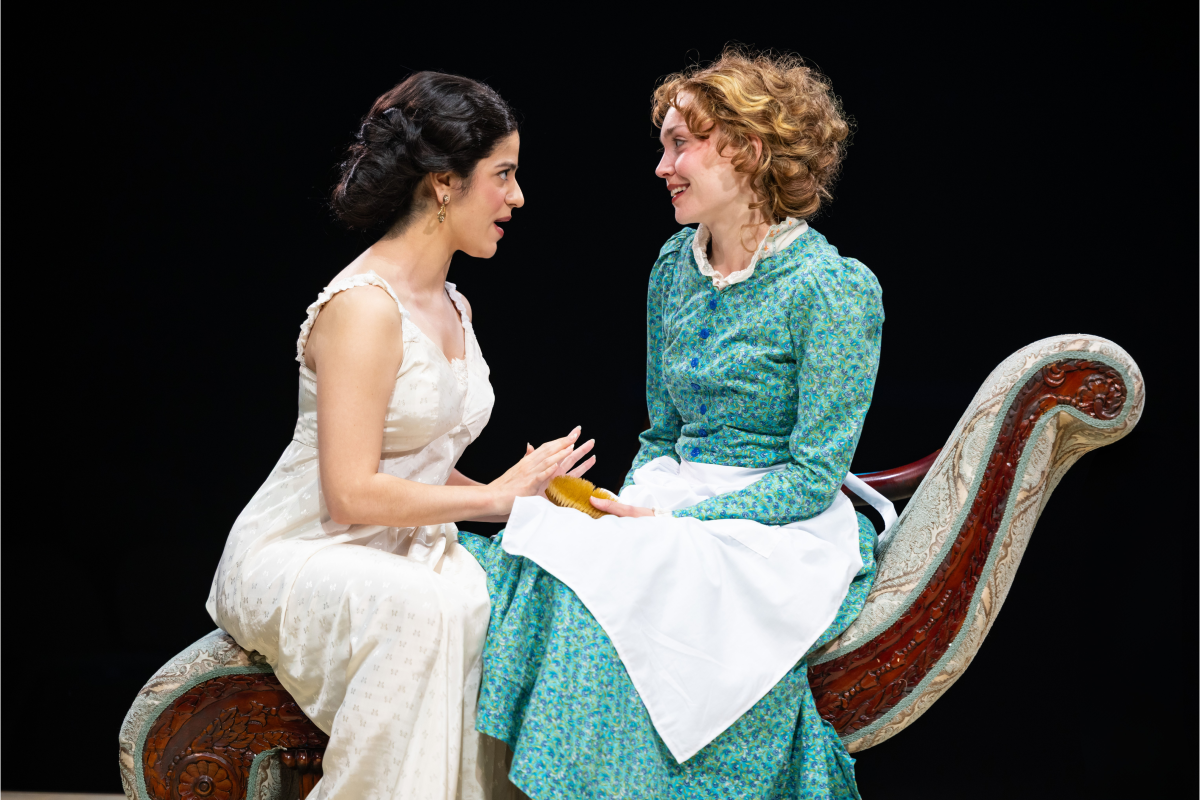
Musical walk with Sondheim and Seurat


Recommended

Have you ever walked through a gallery, studied a face in a painting and wondered who that person is and what is their backstory?

In “Sunday in the Park with George” originally produced in 1982, playwright James Lapine partnered with composer/lyricist Stephen Sondheim to lift the otherwise anonymous images from Georges Seurat’s famed work A Sunday Afternoon on the Island of La Grande Jatte and give them life. This thoughtful conceit takes the opportunity to use these characters to delve into the thought processes of the artist, and earned Lapine a Pulitzer Prize for Drama.

For those unfamiliar with the painting, it can be seen in person at The Art Institute of Chicago. Seurat’s massive nearly 10-foot-wide masterpiece depicts a collection of figures of various social classes strolling and lounging along the Seine River in a park just outside Paris circa 1885. The artist utilizes a technique he developed called pointillism where small dots of pure color are placed very close together requiring the viewer’s eyes to blend them into a wider variety of tones. This was a revolution that ultimately led to the development of the modern four-color printing process.

Seurat’s genius as an avant garde artist and visionary is the basis of this production at the Chopin Downstairs Studio produced by Kokandy Productions under the direction of Derek Van Barham with musical director Nick Sula.

It seems Sondheim took inspiration from Seurat as an opportunity to experiment with his own musical colors and tones. The music here is much more freestyle and amorphous then his previous works. You can hear that the composer is working to blend musical tones and find unusual harmonies combining with his own distinctive use of complex rhythms in an effort to create new sounds — often pleasant, at times assaulting, but always thought provoking. This work has little reference to the works of his mentor Oscar Hammerstein or to our recently reviewed “West Side Story” in which he collaborated with Leonard Bernstein. You’ll be hard pressed to walk out of the theater humming a tune or recalling a musical phrase. But that’s not altogether a bad thing. Sondheim is asking us to think differently to experience his music in a way that is similar to how Seurat’s new approach to visual art was received.

The story is told almost entirely through the interactions between the artist Georges Seurat (Kevin Webb) and his muse Dot (Missy Wise Vanderzee). The massive role keeps Webb on stage nearly the entire time. When not with Dot he is conferring with fellow artist Jules (Danny Andrew Bennett), the Boatman (Nick Arceo) or his mother (Lauren Miller) with whom he has a lovely duet toward the end of Act I.

As always, the entire Kokandy cast offer outstanding vocal performances, particularly evident in the title choral number Sunday in the Park with George. Webb who has also tackled Sondheim in “Sweeny Todd” and “Into the Woods” does a terrific job here with very challenging dialogue and rhythm. The cast is accompanied by the exceptionally capable six-piece Kokandy orchestra, who rise to the complexities of Sondheim’s sophisticated score with confident musicality.

Nathe Robotham as Jules’ particularly tall partner Yvonne is inspired by the central figure in the painting who seems unusually out of proportion. Robotham’s catty performance is amusing and their imposing frame is perfect. Ella Carson as Yvonne and Jules’ daughter is delightful while Arceo makes the most of his role as the gruff boatman.

Act I is a very straightforward dive into the mind of Seurat. Act II takes an unexpected turn, advancing the story about 150 years forward where we encounter another George who may or may not be the great grandchild of the artist. This George is also an avant garde artist experimenting with technology. Through George II, Lapine and Sondheim have a chance to consider the notion of legacy in Children and Art. It is questionable whether George II is actually related to George I but there is an inference that the efforts of George Seurat broadened the idea of what art can be, paving the way for future experimental artists. In this way George II is the inheritor of his legacy.

Lapine and Sondheim also offer a sardonic commentary on the business of making art particularly in the musical number Putting It Together.

There is an attempt at the beginning of the second act to offer a transition in the amusing number It’s Hot Up Here, where the historic characters grouse about being stuck in the painting for eternity.

All in all, Act II is something of a mess that includes a slide show that attempts to educate the audience about Seurat as a prelude to George II’s work. It all seems a bit ill conceived and forced as though there was a feeling the show needed to be longer or needed more of a message. It’s not unenjoyable but just requires you to shift gears for a postlude that apparently has no basis in fact since Seurat and Dot seem to have had two children both of whom died in infancy. But this is theater, not an art history class.

Costumes by Rachel Sypniewski were adequate in Act I but quite inspired in Act II, again poking fun at the perceived flamboyant antics of the modern art world.

I think I understand why Van Barham might have chosen to stage this in the Chopin’s downstairs studio theater in an attempt to create an immersive experience that would bring the audience into the painting and into Seurat’s world but this play begs for a proscenium. It is about the perceived confines of what art is and what it can be. It is about a particular painting in a frame that has very specific proportions and use of space. It is also about perception of outdoor light. It is expansive and needs more air than this venue can provide. Likewise, the lighting by G. “Max” Maxin was limited by the space. From where I was sitting most of the lighting seemed to be directed toward me and often annoyingly in my eyes. The unveiling of the painting was a dramatic surprise but it could not be seen by everyone at the same time so missed a dramatic beat.

Ultimately Lapine and Sondheim’s opus is a theatrical tour deforce with perhaps a few hiccups that is a favorite among sophisticated theater goers who are open to experiencing a challenging score — in this case performed terrifically with great vocals and instrumentation. If you love Sondheim, you’ll love this.

DETAILS: “Sunday in the Park with George” presented by Kokandy Productions is at Chopin Downstairs Studio, 1543 W. Division Street, Chicago, IL through November 1, 2026. Runtime is 2.5 hours with one 15-minute intermission. For tickets and information visit kokandyproductions.com

Review by Reno Lovison

For more shows visit Theatre in Chicago
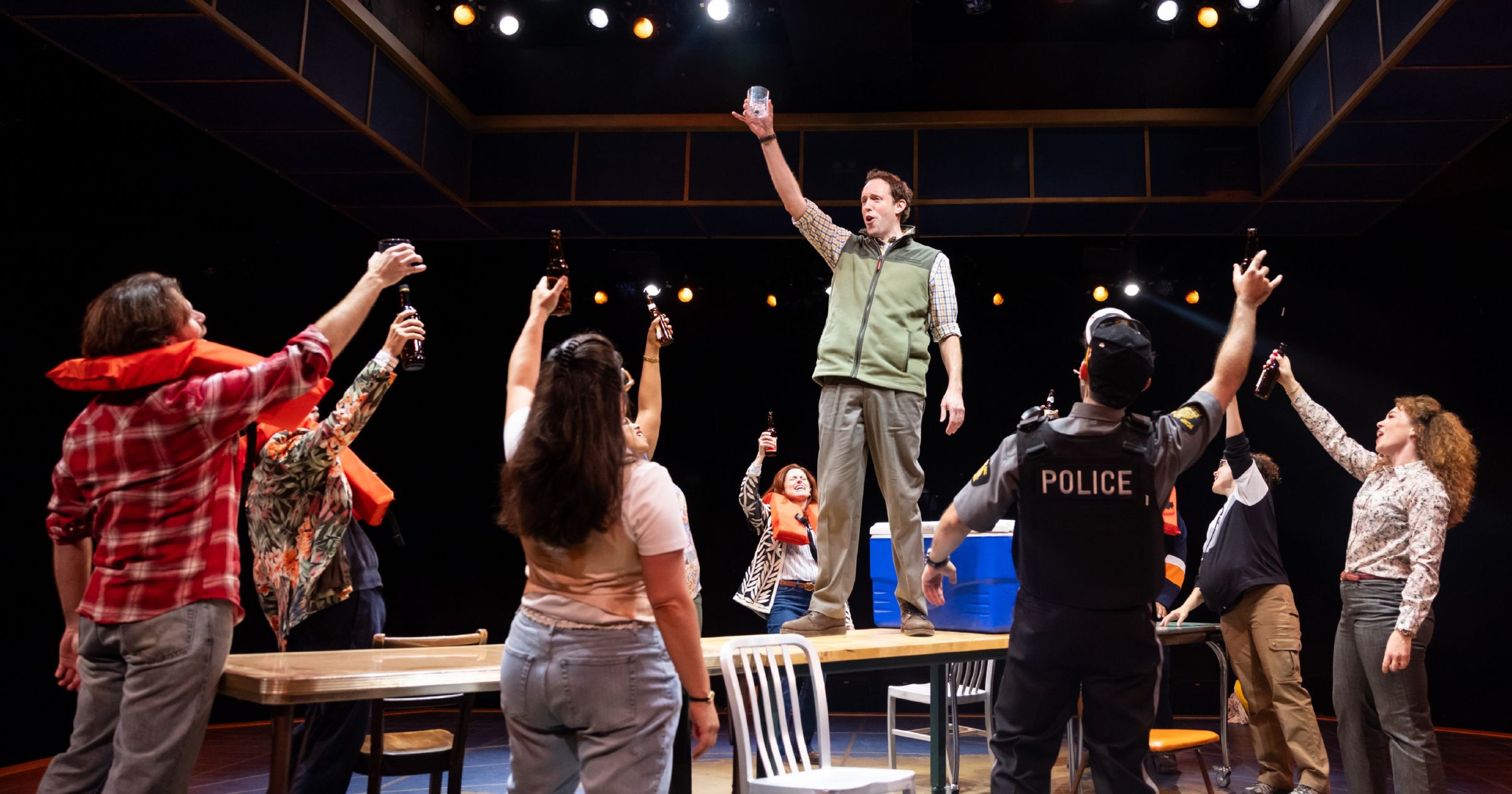
Come from where?


Highly Recommended

Do you remember what you were doing when you heard (if old enough) what was happening 25 years ago in NYC and across the country?

“The borders of the United States are closed.” (That was what passengers of flights to the country were hearing as pilots came on planes’ loud speakers including the flight our daughter was on. She and a coworker were on their way back to California from a work trip to Europe. The date was 9/11.

Her plane landed in Edmonton, the capital of Alberta, Canada. Other planes, about 38 of them loaded with 7,000 passengers landed at Gander International Airport in the province of Newfoundland on the Atlantic coast.

And thus begins “Come From Away,” a much-nominated Tony Award musical by Irene Sankoff and David Hein now on stage at the Marriott Theatre, Lincolnshire. The show is based on some of the happenings of real Gander residents and visitors from an American Airlines flight.

It is a short show of about an hour and a half with no intermission but every minute of it is strong with relationship development and a sense of what Gander is like.

To get a feeling of the moods of the Gander residents and plane’s passengers check out the musical numbers’ titles such as “28 Hours/Wherever We Are,” “Phoning Home” and “I Am Here.”

The play doesn’t really showcase a particular actor because everyone cast plays an integral part. Instead, it reflects how a town and a flight’s passengers react to a totally unexpected happening.

Details: “Come From Away” is at Marriott Theatre, 10 Marriott Dr., Lincolnshire, IL now through Oct. 18, 2026. For more information visit Marriott Theatre, Come From Away

Jodie Jacobs

For more shows visit Theatre in Chicago

West Side Story reflects our problems

slider_2026_season-westsidestory_1600x600

Recommended

“West Side Story” echoes current immigration fear and division.

Music Theater Works (MTW) offers a faithful recreation of Leonard Bernstein and Stephen Sondheim’s now classic contemporary musical reimagining of Romeo and Juliet.

“West Side Story” is a romantic tragedy that tells the tale of young lovers Tony (Luke Nowakowski) and Maria (Isabella Ruano) caught in an impossible netherworld between two rival mid-1950s era New York City ethnic street gangs.

The Sharks are a Puerto Rican gang led by Maria’s brother Bernardo (Emmanuel Ramirez), while the Jets are local “white” kids of no distinct ethnicity, led by Tony’s best friend Riff (Conor Ripperger) who are trying to “protect” their neighborhood turf from the newly arrived immigrant group.

The innocent newcomer Maria meets Tony at a dance in the school gym where Riff plans to challenge Bernardo and The Sharks to a street fight. At this meeting the two leaders will agree on where the “rumble” is to take place and what weapons will be allowed. This sets up the context for the tragic outcome.

Music Theater Works remains true to their tradition of presenting musical theater that stays very close to the original production. There is nothing new or fresh here. This is not an updated version but rather a chance to see the show presented pretty close to how it was conceived by its creators.

That being said, “West Side Story” always felt like a sanitized theatrical view of urban ethnic conflict. I suspect neither Bernstein or lyricist Sondheim had any real first-hand knowledge of these groups. In fact, it is widely known that the story was first conceived by Arthur Laurents and Jerome Robbins as a conflict between Jewish and Irish immigrants on the Lower East Side of Manhattan before ultimately being carried to the other side of the island with an updated spin.

Interestingly this seems to prove that needless violence surrounding immigration fears, misunderstandings and petty power struggles are a continuing issue. Director Sasha Gerritson says, “[This is] what happens when fear and division prevent us from seeing one another’s humanity.”

It may be useful for audiences to understand the historical setting so that it might be enjoyed within the context of the period in which it was created.

“West Side Story” is not intended as a realistic drama but rather a stylized characterization of certain stereotypes utilizing traditional theatrical forms of song and dance to create a mood and express emotion. In this way it has strong roots in European opera and ballet with a mid-century urban vibe that incorporates elements of jazz and modern dance that was particularly cutting edge in the late 50s and early 1960s.

I’m certain Bernstein and Sondheim were cognizant of the challenges related to offering something contemporary while keeping it within the generally conservative comfort zone for audiences of the era. For instance, in the irreverent Act II number “Gee, Officer Krupke” Sondheim finds suitable alternatives to expletives such as the ending “Gee, Officer Krupke – KRUP YOU!”

The story speaks to the timeless human propensity of banding together tribally in an effort to preserve group identity and traditions; to maintain autonomy, and protect geographic territory. In this way “West Side Story” continues to resonate today as new generations struggle with conflicts arising from recently arrived immigrant groups coming with limited resources who seemingly compete for the same jobs and affordable housing as established residents, who then feel they may be displaced.

Affairs of the heart do not always recognize social, economic or political divides. The story attempts to make the point that individuals caught up in this turmoil are just trying to enjoy their life.

After the dance, below the fire escape outside her bedroom window, Tony expresses his love through the song “Maria.” This is a thinly veiled homage to Shakespeare’s famous Romeo and Juliet balcony scene where the two profess their mutual adoration and vow to meet again.

The proscenium arch and backdrop designed by Bob Knuth echo the play’s now‑iconic Broadway album cover, with its striking collage of black fire escapes set against a red background. The addition of a yellow glow augments the visual feeling of the smoldering heat of the lovers’ romance while the jumble of fire escapes isolates their intimacy within a chaotic urban environment.

Pivotal character Anita (Pauleth Jauregui) is married to Bernardo. The more experienced Anita expresses the realities of immigration against the idealism of Rosalia (Harmony Rose) in “America” a number that perfectly showcases the ideal partnership between Bernstein’s rhythmic musical talent and Sondheim’s playful use of language. Later Anita admonishes Maria in “A Boy Like That” urging her younger sister-in-law to “Stick to her own kind” further emphasizing the fears that underpin the story’s conflict.

Ruano and Nowakowski each bring a considerable operatic intensity in the upper range of their voices providing requisite emotion in songs like “Maria,” “Something’s Coming”, and “One Hand One Heart.” Sound designer Stephanie Farina should be able to help them out a bit on the lower end of their range where their power is a bit weak.

The haunting tune “Somewhere” is the musical basis of a ballet dream sequence that imagines the lovers have found their safe and happy place. In this production the vocal portion is begun by Shark girl Consuela (soprano, MJ Bueno) then joined by Jet gang member Baby John (Jaxson Smith) before the entire Company dressed in white joins in a powerful chorus.

Conductor Justin Kono leads the 22-piece pit orchestra through Bernstein’s challenging score providing the audience with a rare chance to hear a large musical theater ensemble. This is one of the unique and well appreciated aspects of Music Theater Works.

The dance numbers are, and always have been, integral to “West Side Story.” Originally conceived by Jerome Robbins the stylized movements with roots in modern jazz and ballet punctuate emotions in numbers like “The Dance at the Gym,” “Rumble,” “Jet Song” and “Cool.” MTW co-choreographers, Clayton Cross and Isa Ramirez with Alex Villasenor do a good job of keeping this company in step, staying true to the original vibe.

The inclusion of Spanish language supertitles above the proscenium with translations by David Serrano is a new addition in this production offering a nod to the multi-cultural aspect of the story and providing a welcoming experience for a wider audience.

Overall, this is an enjoyable, solid production in a great venue with strong musical and dance performances all around. “West Side Story” echoes current immigration fear and division.

West Side Story is presented by Music Theater Works at the North Shore Center for the Performing Arts, 9501 Skokie Blvd., Skokie, IL through August 30, 2026. Runtime 2 hours and 30 minutes with one intermission. For tickets and information visit MusicTheaterWorks.com or call the box office at 847.673.6300.

Writer: Reno Lovison

Chicago Air and Water show


U.S. Air Force Thunderbirds (Photo credit Patrick L. Pyszka, City of Chicago)

U.S. Air Force Thunderbirds

Officially the 2026 Chicago Air and Water Show is 10:30 a.m. to 3 p.m. Saturday Aug. 15 through Sunday Aug. 16.

But folks in the know from previous experience head over to the lakefront at North Avenue Beach to watch the show’s “rehearsal” on Friday when the waterfront is not quite as crowded. The weekend event can also be viewed during the day along the beach from Fullerton Ave. to Oak Street. (See more info at DCASE Homepagee at Chicago Air and Water.

What to expect

This year the US Air Force Thunderbirds will fly over the area during the show. Another prime feature is the United States Army Parachute Team  called the Golden Knights.

Then there are the military groups:

The U.S Air Force C-17 Demo – 15th Airlift Squadron, the Illinois Air National Guard KC-135 Stratotanker and a demonstration by the Coast Guard search and rescue by a MH-65D Dolphin helicopter aircrew. 

Plus four F16 teams: the F-22 Raptor Demonstration Team, the USMC F-35B Lightning II Demonstration Team, the 162nd Wing unit of the Arizona Air National Guard from the Morris Air National Guard Base, Arizona, the 152nd Fighter Squadron (152 FS)  that is a unit of the Arizona Air National Guard 162nd Fighter Wing located at Tucson Air National Guard Base, Arizona.

But the show is not just by military performers.

Susan Dacy performing maneuvers in the Super Stearman

“Big Red” flown by Susan Dacy

You have Kevin Coleman’s acrobatic stunts, Susan Dacy flying the Super Stearman “Big Red,” retired USAF Col Ed Hamill flying the Folds of Honor Biplane and the Trojan Phlyers Flight Demonstration Team.

In addition, there is a Chicago Police Dept. helicopter team and a Chicago Fire Dept sea rescue team. 

Just bring enough suntan lotion and liquids to last half a day and enjoy the action.

Jodie Jacobs


HAIR Past present or hope for the future?


Recommended

HAIR – is it a nostalgic romp or does it have relevance to a contemporary audience?

I’m struggling to look at HAIR with fresh eyes and consider if this theatrical offering can be understood or enjoyed out of context. On the surface it is a collection of musical vignettes performed by a ragtag group of nihilists. But who are they and what are they trying to say?

The original production, with book and lyrics by Gerome Ragni and James Rado and music by Galt MacDermot, opened in 1967 before moving to Broadway in 1968. It was a successful contemporary attempt to celebrate and explain the counterculture to a confused older generation grappling with the poorly understood perceived antics of their progeny.

I think it is interesting to note that Bob Dylan wrote, “The Times They Are a Changin’” in the fall of 1963 including the lines:

Your sons and your daughters are beyond your command. Your old road is rapidly agin’.

Please get out of the new one if you can’t lend your hand, For the times they are a changin’.

Dylan seemed to have a keen recognition of what was happening and premonition of what was to come.

In 1968, the leading edge of the baby boom reached adulthood, with roughly 12.5 million Americans being between the ages of 18 and 21. This generation had grown up under the shadow of nuclear annihilation and came of age during the height of the Vietnam War, when a mandatory draft policy placed every young man in that cohort at risk of being arbitrarily selected for combat service.

HAIR is a take on postmodern existentialist philosophy toned down a bit for a more mainstream audience.

It is not a story but rather an expression of anxiety, freedom, responsibility, authenticity, absurdity and individual human existence in conflict with collective society. In this sense a modern audience will find some correlation to the current times.

With roots in abstraction and dadaism HAIR is amorphous and messy but that is part of the experience. The best way to enjoy this production is to simply let it wash over you. Do not fight it but rather go-with-the-flow.

The loose backstory is that of Claude (Gavin Rhys), a member of a Hippie tribe who is conflicted over his willingness to completely join the rebellion by burning his draft card and defying the draft.

He and his “tribe” are immersed in the newly emerging trends of sex, drugs and rock & roll which would become one of the slogans of the time. All of this was a clear reaction to the repressive conservative norms of the previous generation. Hence the term counterculture.

Males wearing their hair long was the most iconic physical manifestation of the period becoming the very definition of the movement and the inspiration for this show’s title and song which celebrates the symbolic gesture.

The production opens with “Aquarius” sung by Dionne (Chosen Mitchell) and the Tribe. The lyrics set the tone for the idealistic and hopeful yearnings of a generation looking for meaning in life and a brighter future where “peace will guide the planets and love will steer the stars.

Looking to Astrology for the answer is a further rejection of traditional religion and the status quo. The song became something of an anthem for the time. Toward the end of Act One, “Be-In” a/k/a “Hare Krishna” is a nod to the influence of South-Asian Indian culture. While “Good Morning Star Shine” is yet another reference to being one with the cosmos.

“Donna” presented as the second song is a throw-back to earlier rock & roll love songs with a bit more edge setting up a contrast of what is to come with much more edgier sex songs like “Sodomy” and “Black Boys/White Boys.” These songs together with “Colored Spade” and “I’m Black” remind us that attempting to improve race relations was very much a part of the counterculture.

A defining feature of the time was the presence of mind-altering substances being embraced by large numbers of young people including marijuana and LSD used both in an attempt to expand consciousness and a way to manage anxiety. “Hashish” “Ain’t Got No Grass” and “Initials” set us up for Claude’s hallucinations in Act Two with “Walking in Space” “Abie Baby” and “The War.”

As for Vietnam which is of course a central theme, the song “Three-Five-Zero-Zero is a reference to U.S. propaganda suggesting that the Vietcong were sustaining 3,500 losses per month hence reducing human life impersonally to mere numbers. This would be difficult to understand without some reference.

Sheila (Catherine Rodriguez O’Connor) is the voice of experience in “Easy to Be Hard” lamenting how some people can be cruel and indifferent to the individuals around them even as they claim to care about the masses. Conversely Crissy (Amy Yesom Kim) sings a sweet song of naive love in “Frank Mills.”

Important and interesting is “Air” sung by Jeannie (Allyriane Huq) with Crissy and Dionne raising awareness of the then relatively new public concern about the impact of pollution.

In the end this is a celebration of youthful idealism confronting the realities of life within a particularly unique historic period.

As humans we are individuals who are also part of a collective, expressed by Claude in “I Got Life” and “Where Do I Go.”

Many of the themes are universal truths related to the human experience while some are very specific to the time. “Let the Sun Shine In” is both tragic and uplifting as life and growth do not occur without pain and loss.

The Kokandy cast, as always, delivers on vocal quality and has put their own spin on this now classic musical. Costumes by Rachel Sypniewski are reminiscent of the period but not derivative opting to embrace the ideas of eclectic individualism over period realism. The same is true of the make-up design by Syd Genco as well as hair and wigs by Keith Ryan.

I loved the concept behind the scenic design of Eleanor Kahn featuring plain light toned wooden risers emblazoned with graffiti which again included both vintage and contemporary slogans. It was fun that the audience was invited to add their own personal touches during the intermission.

I guess I opted in this review for some context by providing a kind of cheat sheet that might make this a bit more enjoyable for audience members who may be a little confused about what is happening, especially if not familiar with the lyrics.

This was written for the audience of the time and many references were just simply understood. At this point there are a few numbers that can be cut in order to bring the overall runtime down maybe 15 minutes or so.

For those looking for a simple nostalgic experience, this is more of an interpretation than a recreation. For younger audience members you’ll enjoy the retro vibe and find relevance in the message.

DETAILS: HAIR by Kokandy Productions is at Chopin Theatre, 1543 W. Division Street, Chicago, IL through September 13, 2026. Runtime is 2.5 hours with one 15-minute intermission. For tickets and information visit kokandyproductions.com

Review by Reno Lovison who auditioned for the Chicago cast in 1969 alongside Mandy Patinkin. “Neither of us got hired.”

For more reviews visit Theatre in Chicago

Off out beaten entertainment path – an impromptu daytrip to Milwaukee


Provided by Wikipedia

(Photo compliments of Milwaukee Art Museum)

Many Chicagoans may not even realize there is a sizeable attractive, action-filled metropolis a mere 90 miles north of the loop that makes Milwaukee a perfect destination for a one-night stay or daytrip.

On a whim, after planning and hosting a gathering for over 60 friends and family the previous weekend we decided to escape Chicago on the 4th of July to spend a night in Milwaukee.

Finding where to stay

To begin our brief adventure, I chose to spin the proverbial wheel using “express deals” at Priceline.com to determine where to stay. The site indicated about six 4-star hotels downtown that all sounded fine to me.

We drew the Hilton on Wisconsin Avenue across from the convention center. This was the former Marc Plaza a period hotel built in 1928 that has been very well maintained and reminiscent of the Conrad Hilton, the brand’s flagship Chicago hotel though considerably smaller.

Our room on the 16th floor with one King bed was very clean, large and luxuriously appointed with contemporary furnishings including a recently renovated bath. In spite of the location next to the elevator it was very quiet. There was a minibar and a big screen TV that greeted us with a personalized welcome message.

The ample hotel lobby has a charming early 20th Century vintage vibe with very high ceilings and wood trim with gold accents. Also, there are three restaurants on the property and room service is available.

Our discounted price was just under $150 for the night including taxes and fees, easily 1/3 lower than any of the other posted rates for the same hotel online. I got another $15 rebate using my Capital One card.

Once we arrived, I learned that parking was an additional $40 per night with in-and-out privileges. I decided to check my Spot Hero app and noticed there were several nearby options at half the price. However, since it was Saturday night and metered parking was free all day Sunday I was able to park on the street across from the hotel for free.

We checked in after 4PM then took a ride through downtown and around the east side of the city, which like Chicago is the lakeside. This is really a great get-a-way location and ideal for those looking for a big city experience that is not on the hectic level or scale of Chicago.

Beginning with an architectural adventure

Driving east from the hotel on Wisconsin Avenue I was struck by how much of the 1880’s era architecture this city has retained. Chicago has eradicated most of the enormous terracotta clad brick “skyscrapers” that defined the growing urban centers of the late 19th and early 20th century.

In this case, the Federal Building & Courthouse (1892-99) with its large stone columns; the Iron Block Building (1860) with its cast iron facade; the Pfister Hotel (1893) is the picture of Gilded Age Luxury and the Chamber of Commerce Building (1879-90) on Broadway, features an impressive façade of carved ornamentation.

There are numerous additional architectural gems spanning over 150 years to find and explore from Buckminster Fuller’s geodesic domes (1967), Frank Lloyd Wright’s Burnham Block (1912-16) to The Calatrava “Wings” (2001) part of the Milwaukee Art Museum — a movable sunscreen that opens and closes like a giant bird and is one of the most recognizable architectural features in the world.

Fireworks on the lakefront

We headed north along Lake Drive in search of some 4th of July fireworks and settled in Atwater Park just past Capitol Drive in the adjacent suburb of Shorewood. It is the equivalent of Evanston in Chicago in terms of proximity to the northern boundary of the city.

The park features a dramatic bluff about 70 feet high overlooking Lake Michigan and has a dramatic switchback path down to the beach that is enjoyable during any visit.

Luckily, I keep a couple of foldable camp chairs in my trunk which we grabbed and walked about two blocks from Edgewood Avenue and Lake Drive.

Edgewood Avenue has a number of impressive mostly single-family homes built between 1915 and 1935 that are a mix of Tudor Revival, Colonial Revival, and Mediterranean‑influenced architecture on sizeable lots that range in price between $1 million to over $2 million.

We situated ourselves comfortably near the entrance of the park next to an illuminated public art installation of a seated human figure made of interlocking alphabetic characters forming a hollow, mesh‑like body by Jaume Plensa called Spillover Il.

Since the fireworks were being launched from the beach below, we were easily half way to where they ultimately exploded providing us an intimate immersive experience.

By the way, this is a nice drive and a spectacular view even when there are not fireworks to enjoy.

Afterwards we made our way back to the hotel to enjoy a cocktail and split an order of BBQ pulled pork sliders for a perfect late-night snack at the Miller Time Pub & Grill in the lobby.

Sunday Day Tripping

Now this is where things get a bit more interesting for day-trippers as the rest of this article is about how we spent a random Sunday in Milwaukee without really planning ahead.

We got kind of a late start because we just are not “crack-of-dawn” people  which is one of the reasons we chose to stay the night. So, we were in search of Sunday brunch rather than breakfast.

Day tripping this will show that you can take a couple of hours to get up to Milwaukee on a Sunday and still have a nice full day experience. By the way if you choose not to drive, Amtrak has two Sunday morning trains that get in at 10:00 AM and 12:45 PM near the Hilton (check current schedules of course). Then getting around the city is quite easy by foot and/or via rental bike, scooter, bus and or a free tram.

In search of Sunday brunch

We first looked at the 3rd Street Market Hall on Wisconsin Avenue purported to be the second-best food court in the country according to USA Today. Featuring 20+ food vendors and a unique self-serve beer tap wall, it’s modern and family friendly though a bit more meat and drink forward then we were hoping for.

We also wanted to be outside. With no plan in mind, we headed on foot a few blocks north on Dr. Martin Luther King Jr. Drive to the 3rd Street Historical District.

This is a roughly a one block stretch of quaint old Italianate storefronts with a German vibe leftover from when this was the core of the German-American commercial area of the 1860s and early 1900s.  Anchors on the street are the iconic Mader’s Restaurant and the Usinger Sausage Headquarters with the Pabst Brewery Complex nearby.

The three or four pubs on the street are more geared to beer and sausage than Sunday brunch but we landed outside the “Old German Beer Hall” whose chalkboard outside said “Sunday Brunch” including Chicken Schnitzel & Waffles ($14) and Bavarian Skillet ($14). We got one of each.

Surprisingly, they did not have coffee. So after we ordered I walked back a block to Starbucks in the Hyatt for a couple of Ventes.

The outside is long tables and benches and inside is classic old school German Hofbrau.  This would surely to be a great place to watch a game or hangout with a group of friends. Food here is an afterthought and I give it a solid five out of ten but it was an overall pleasant experience. If you’re looking for sausage and beer you will do well in this area. If you’re looking for a brunch experience do a little more research and plan ahead.

A waterfront boat ride

We thought we would enjoy the Milwaukee Art Museum which alone is well worth the trip. But since it was nice summer weather and we were near the river we decided to do a river excursion which was the highlight of the day. We’ll save the museum for another trip in the fall or winter.

We opted for the mimosa Sunday Funday excursion on the Harbor Lady rather than the narrated historic tour on the Edelweiss. I think either (about $30 for 1.5 hours) would be fine but I was not in the mood for taking in a lot of information and instead just wanted to enjoy the sights. Tickets are available online at edelweissboats.com or at their ticket office on Highland at the river. By the way the riverwalk is a nice place for a stroll either before or afterwards.

The excursion from the landing along the river and out to the harbor was delightful. Great architecture along the way. A view of several bascule and lift bridges as well as an opportunity to view the activity along the shore and in the water including kayaks, sailboats, motor craft and other excursion boats.

Some highlights of the trip included viewing the Daniel Hoan Bridge from the lake with its bright yellow arch design that soars almost 120 feet above the water terminating on the north end near the Summerfest grounds.

We also passed the stunning Milwaukee Art Museum and got a glimpse of the Historic Third Ward which was our next destination.

The Historic Third Ward

By this time, you might gather I enjoy vintage architecture and Milwaukee has it in spades. Many years ago when were first married we lived here for three years and none of this was developed. The 3rd Ward area at that time was just a collection of mostly derelict light industrial and manufacturing buildings.

Now it is a very hip neighborhood of small businesses, trendy condos and a variety of neighborhood bars and restaurants along the river with the focal point being the Milwaukee Public Market reminiscent of Pike Place Market in Seattle with a large contingent of both prepared food and grocery vendors as well as of course plenty of beer options. We were looking for something light and opted for a couple of delicious tacos and lemonade at a bar near the front door. 

A free ride

After exiting the market we spotted the Milwaukee Hop, a modern streetcar that uses both a pantograph (overhead electric lines) and its own battery power for certain segments. What caught my eye was the sign in the window that said, Free Rides. We thought, “what the heck” and got on, not knowing where it went.

As it turned out it was a very pleasurable easy tour of the city that passed by some of the places and buildings we had seen and many we had not. This is another great way to do some significant building and people watching. If you are inclined you can get off and explore then continue on to the end of the line (like we did) or grab another trolly back to where you began.

As it was, we logged about 4 miles of walking by the end of the day, so I did not mind doing a little riding as well by boat and trolly.

Meeting people

I don’t know if Milwaukee is any more friendly than anyplace else but we had a few enjoyable encounters. All of the waitstaff we interacted with were particularly nice and accommodating. At the fireworks we met a retired couple from Michigan now living in Milwaukee who told us about using the ferry from Milwaukee to Michigan to visit her elderly father. Sounds like a possible future trip idea.

On the boat we chatted with a nice fellow visiting from Sheboygan for the day and on the trolly we had a nice conversation with a young couple living in Milwaukee who were on their way to meet friends at the Public Market.

On the way home

No trip to Milwaukee is complete for us without a stop on the way out of town at Leon’s Frozen Custard on Layton on the south side. Established in 1947 this is not retro it is the real deal. A massive neon emblazoned frozen custard stand featuring outstanding frozen custard offered in a spectacular vintage drive-up only edifice.

One last tradition is an obligatory visit to the Mars Cheese Castle outside Racine on I94. If you forgot to pick-up some beer or cheese in Milwaukee this is you last chance to make your purchase with authentic Wisconsin hospitality. I have a friend that insists I bring him two or three loafs of cheese bread from their bakery and I’m fond of the giant elephant ear cookies which seem hard to find in Chicago.

This is hardly everything there is to do in Milwaukee – it’s not even a list of the best things to do, but hopefully it will inspire you to plan a day trip of your own when you just want to go someplace nearby for a short get-a-way.

Reno Lovison

(Reno Lovison is a Chicago video marketing professional and theater reviewer)


A Little Light Music


Recommended

With music and lyrics by Stephen Sondheim and book by Hugh Wheeler, audiences can expect a fine evening out at Marriott Lincolnshire for “A Little Night Music.”

This is a period piece taking place in Sweden sometime around the late 1800s to very early 1900’s.

You’ll meet Madame Leonora Armfeldt (Carmen Roman), an aging former courtesan, and granddaughter Fredrika (Olivia Grace O’Sullivan).

Then, we meet Fredrik Egerman (Andrew Samonsky), a successful lawyer and his new wife, Anne (Addie Morales), a young, naive, inexperienced girl whom we learn near the end of the first act is still a virgin even though they have been married for months.

You’ll also meet Fredrik’s son, Henrik, (Eldon Warner Soriano) a seminary student who is older than his stepmother.

Fredrik surprises Anne with tickets to a show starring Desiree Armfeldt (Alexandra Silber), an actress whom Anne admires and who, unbeknownst to Anne, Fredrik already knows.

At Desiree’s apartment Fredrik encounters another of her lovers, Count Carl-Magnus Malcolm (Alan H. Green).

To make relationships even more complicated Carl-Magnus is married to  Countess Charlotte whose young sister, Marta, is Anne’s friend.

Anne and Marta

The first act ends with the characters taking off for a “Weekend in the Country,” an upbeat tune.

You’ll have to see the show to know what happens then.

Directed by Nick Bowling and choreographed by Katie Johannigman, “A Little Night Music is a fun, little night out.

DETAILS: “A Little Night Music” is at Marriott Theatre, 10 Marriott Dr., Lincolnshire, IL. now through Aug. 9, 2026.

Jodie Jacobs

For more show reviews visit Theatre in Chicago

World Premiere of a new musical classic


Highly Recommended

Scaramouche is a stock character in Italian commedia dell’arte who is seen as an unscrupulous, boastful, and often cowardly rogue whose swagger collapses the moment real danger appears.

This City Lit world‑premiere musical adaptation of Scaramouche by Kingsley Day and James Glossman based on Rafael Sabatini’s novel is set in 18th‑century France on the eve of the French Revolution.

After the death of his friend Phillipe (Connor Ripperger) at the hand of the Marquis de la Tour (Kent Joseph), Andre‑Louis Moreau (Ethan Smith) boasts of retribution yet fails to follow through.

Convinced by his cousin Aline (Laura Michele Erle) that he is in mortal danger, Moreau flees, joining a troupe of travelling actors where he in fact takes on the role of Scaramouche.

What ensues is a series of political intrigues and personal interactions that depicts Moreau’s life journey ultimately bringing him to understanding his true self.

In addition to his contribution as co-author, Kingsley Day has done a terrific job with the music and lyrics. The overall style harkens back to a more traditional approach. There are no big soaring production numbers prevalent in contemporary musicals but rather a staggering 30 or so creative melodies and recitatives that feature surprising harmonies that seem perfectly at place in the story’s time period. This is most notable in “A Family Reunion” sung as a four-part vocal quartet in counterpoint reminiscent of a Mozart opera. “Entitled to be Happy” sung as a charming duet by Aline and Moreau sets the tone of their relationship.

Demonstrating a prodigious vocabulary, Day shows he has done his research into the subject matter and lexicon of the period, pairing a variety of complex words in unexpected ways with wry wit and delightful comic effect.

A familiar figure in the Chicago theater scene, Day reveals his considerable acquaintance with Gilbert and Sullivan in several of the numbers, while in “A Brand-New Play” he provides an homage to the rapid-fire patter song of Kurt Weill and Ira Gershwin made famous by Danny Kaye’s rattling off the names of fifty or more Russian composers. In this case a shorter list of French playwrights. Adding to the humor is Day’s tongue-in-cheek reference to himself with Moreau explaining the secret to writing a good play is to borrow from the best. Which incidentally Day has accomplished brilliantly.

Music Director and accompanist Kevin Zhou with the assistance of Tyeese Braslavsy and musicians Chad Polk, Aaron Kaplan, Matthew Beck, and Adam High introduced this new work admirably including the use of woodwinds and strings to augment the period effect.

The vocal performances of the company were all excellent however about half the cast seemed to lack the vocal power needed to really push their numbers to full effect. This was due in part to the interesting vocal range demanded by Day’s compositions.

The lack of amplification was a factor, which is indeed a feature of modern theater and musical vocal performance generally. I understand that in the small space of the City Lit theater it seems unnecessary but in fact the room does not have ideal acoustics especially when singers are competing against live instrumentalists. Many of the low notes got lost and some of the endings never got the full-bodied top notes they deserved. The performers were hitting the notes but the volume was often quite soft. This is more of an observation than a criticism. It did not detract from our enjoyment of the performance but both my companion and I had the same experience.

Smith as Moreau sets the pace managing the demanding role well, being onstage nearly all the time and participating in ten out of the fourteen musical numbers in the first act.

Each of the supporting actors played multiple roles with perfection beginning with Connor Ripperger (I remember as Pippin at MTW) who has a good strong voice and considerable stage presence. The same is true of Kent Joseph whose stature and voice gave a commanding bearing to The Marquis and a devilish characterization as a member of the theater troupe.

Henry Michael Odum who appears in three roles as uncle; leader of the acting troupe; and fencing master are all skillfully related as they are all mentors to Moreau. Odum gives each a slightly different supportive twist.

Erle as the ingénue Aline and Alicia Berneche as Madame provided full throated performances that helped to bring some appreciated vocal dynamics to the production.

India Huy was perfectly coquettish as love interest Climene while Shea Lee was a scene stealer in her comic portrayal of the elderly maidservant.

The trio of “Royalists” (Kent Joseph, Rushil Byatnal, Ed Rutherford) had their moment in the perfectly evil “Robin Redbreast.”

The set design of Trevor Dotson with raised section and projected background, providing a screen for the onstage musicians, was perfectly suited to the small confines of the City Lit performance area.

The lighting effects of Jackson Mikkelsen was very effective in managing the mood and offering a certain muted vintage quality to the production.

Costumes by Jennifer Mohr were appropriate including the use of scarves and sashes that added dramatic flair to the action.

Physical movement is constrained by the available space but the sword fighting was very well managed and the Ensemble movements of the acting troupe with its homage to Fosse was very funny.

Director Beth Wolf did a tremendous job pulling it all together. The press opening performance was flawless. This cast was well prepared, ready and on-pointe in every way.

This may not have the scale of the modern blockbusters and might seem a bit old-school to some but it is a well-conceived, well written production with a good balance of drama and humor that includes interesting and approachable music and lyrics wrapped in an interesting story. Don’t miss it.

Scaramouche is presented by City Lit Theater Company at 1020 W. Bryn Mawr, Chicago, IL 60660 (on the second floor of the Edgewater Presbyterian Church). Runtime is about 2 hours with one 15-minute intermission. Visit citylit.org for tickets and information.

Reviewer: Reno Lovison

Putting a Price on Loss

Windfall

Recommended

When a widowed father is informed that his child has been killed during a protest, he’s forced to consider whether a cash settlement can possibly soothe his grief — causing us to witness how public institutions and

policies, in an attempt to remain impartial, reduce tragedy to a transaction that ignores emotional needs of individuals.

This somewhat mystical world premiere production by Tarell Alvin McCraney has Mr. Mano (Michael Potts) receiving advice from his dead son Marcus (Glenn Davis) who wants him to take the money and run.

In the meantime, Mr. Mano is under intense pressure from three government representatives — each played amusingly with varied personas by Alana Arenas  — to accept their settlement offer.

While processing all of this, the father reviews his relationship with his now lost child who has transitioned from adored daughter Elizabeth to young adult activist Eli (Esco Jouley). It apparently has caused some previous conflict between them which Mano has worked diligently to resolve and now must reconcile.

Directed by Awoye Timpo each member of this talented Steppenwolf ensemble put in strong performances led by Potts who sets the emotional tone and rhythm of the story that revolves around his struggle.

The playful banter of Davis as Marcus, and Arenas as the three bumbling bureaucrats combined with the youthful exuberance of Eli’s companions (John Michael Hill and Namir Smallwood) lighten the mood in what could devolve into a particularly oppressive topic.

Details: “Windfall” is at Steppenwolf, 1646 N. Halsted Street, Chicago, through May 31, 2026. Runtime is about 2 hours with a 10-minute intermission.  Visit Steppenwolf.org for tickets and information.

Review by Reno Lovison

For more shows and reviews visit Theatre in Chicago

How to interpret Ruthless

Ruthless 2.jpg

Catharina Araujo as Tina Denmark

Recommended

What if it’s the young actor and not the stage mother who is “ruthless?”

In Act I of Citadel Theatre’s “Ruthless,” we find a second grader who wants to be the lead in her class play so much she is willing to get rid of the classmate who has that part.

In the show on stage at Sunday’s performance that “ruthless” youngster as the wannabe star Tina Denmark is Catharina Araujo who alternates with Olivia Mulder in the role. Araujo is terrific and believable.

But wait.

We learn at the end of Act I from her grandmother, a theater reviewer, that her mom, Judy Denmark (Annie Beaubien) is the daughter of an acting family.

The show is full of surprises.

As the curtain closes on the first act we see a formerly low-key mom as someone who might have been in “Gypsy.”

Details: “Ruthless! The Musical” is at Citadel Theatre

in Lake Forest, IL. through May 17, 2026.

Jodie Jacobs

For more shows visit Theatre in Chicago