Faith and love in The Sugar Wife


Highly Recommended

Repression, Power, and Renewal

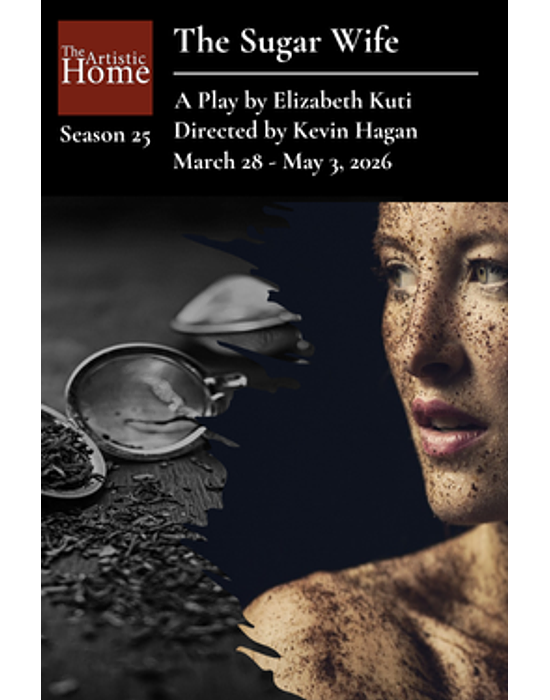
A Quaker couple living in Dublin, Ireland circa 1850, invite a former enslaved African-American woman and her companion to spend ten weeks in their home while touring the British Isle promoting the abolitionist movement.  Their visit concludes on the spring equinox bringing a promise of rebirth and new beginnings.

The Sugar Wife is a story of devotion in all of its manifestations including faith, love, and charity — as well as devotion to work and artistic expression. The pivotal titular character is Hannah (Annie Hogan) whose husband Samuel Tewkley (Todd Wojcik) is a sugar and tea merchant.

On the surface the couple are devoted to their religion and to each other living a comparatively comfortable affluent life while maintaining a superficially austere façade consistent with Quaker ideals.

Hannah endeavors to offset their privilege through myriad good deeds and charity work represented here primarily though her visitations to Martha Ryan (Kristin Collins) a syphilitic sex worker who is literally on her deathbed.

Having visitors for nearly three months brings a level of intimacy that causes each person to reveal much of their inner character, exposing painful desires, repressed passions and secret motivations.

Sarah Worth (Ashayla Calvin) the formerly enslaved woman is accompanied by Alfred Darby (John LaFlamboy) a privileged white man who bought her freedom. Darby an amateur photographer, engaged in the nascent art form, acts as her manager, arranging her speaking opportunities, though it is apparent their relationship is more complicated than it appears on the surface.

Integrity is the alignment between what you believe, what you say, and what you do and is a key element with each character. Keeping this balance is a constant human struggle. Many people make bargains with themselves to justify actions that are in conflict with their ideals, some repent and other simply surrender to their baser instincts.

Weaving throughout the story is a theme of sexual power represented by a slave, a prostitute, and a woman in an unhappy marriage. But this theme is not simply one of domination but rather one of symbiosis as the players leverage their power to maintain their own survival and meet their own objectives.

In the end, with the coming of spring, the question becomes whether they can each emerge from their cold dark wintry past and find a new way forward.

The U.S. Premiere of The Sugar Wife written by Elizabeth Kuti and presented by Artistic Home is expertly directed by Kevin Hagan in the round providing a particularly intimate experience.

The exceptional cast is headed tenderly by Annie Hogan. In spite of his character’s personal failings Todd Wojcik portrays Samuel with a sympathetic and oddly endearing quality that adds pathos to his inner conflicts.

I wish Ashayla Calvin as Sarah Worth had been given more to do. Her understandable detachment from the others makes her feel present mainly to motivate them – – though her oratory vignettes were powerfully delivered giving her notable talent a few welcome opportunities to shine.

John LaFlamboy portrayed Sarah’s companion Alfred Darby with an undercurrent of danger that keeps you wondering about him while Kristin Collins as the bedridden Martha injected a bit of dark comic relief delivering a defiant air that suggested she was not giving up the ghost easily.

This is a provocative and intellectually engaging examination of integrity and interpersonal relationships within the context of rigid social constraints and gender expectations of the 19th century.

Details: The Sugar Wife is at Theater Wit, 1229 W Belmont, Chicago IL through May 3, 2026. Runtime is about 2 ½ hours with one intermission. For information visit theaterwit.org or call 773-975-8150.

Review by Reno Lovison

For more reviews visit Theatre in Chicago
 

Psychological ‘The Sound Inside’ opens Goodman live series

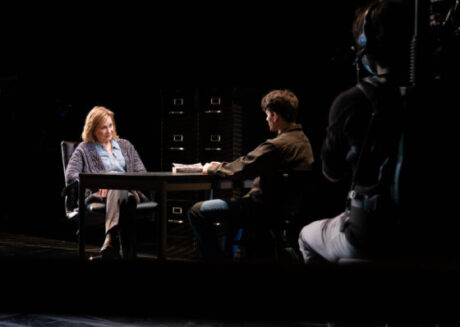
Bella, Mary Beth Fisher and Christopher John Drea, in Adam Rapp's 'The Sound Inside' streaming live from Goodman Theatre. (Photo by Cody Nieset
Bella, Mary Beth Fisher and Christopher John Drea, in Adam Rapp’s ‘The Sound Inside’ streaming live from Goodman Theatre.
Photo by Cody Nieset)

3 stars

“The Sound Inside,” by Adam Rapp, the Jefferson Award winning and Pulitzer Prize nominated playwright of “Red Light Winter,” is a perfect choice for Goodman Theatre’s first live performance on its Owen Theatre stage.

A 90-minute drama that will have audiences wondering what happens next, the play follows the high intensity interaction between a Yale professor who teaches a writing class and a student.

The difference in watching this play from last year’s pre-pandemic, in-person shows and the streaming plays mounted in 2020 and still going on, is that the audience is not filling Owen’s seats and that the action is not pre-taped.

Viewers are at home watching the action as it happens. (Camera angles are important and included in the photos)

Because some scenes seem to be wordy and others might make audiences who think too much information might want to fast forward, which of course, they can’t, the fact that this is live is actually good.

What may sound like background information is crucial to the psychological buildup behind each character’s behavior, responses and the play’s conclusion.

The characters are Bella Lee Baird, interpreted brilliantly by Mary Beth Fisher as a 50-something creative writing professor who is struggling with a recent diagnosis of stage 2 cancer, and Christopher Dunn, superbly played by John Drea as an antisocial, anti- technology  freshman in her Reading Fiction for Craft course.

Christopher sees Twitter as an outlet for those people “scared of loneliness.” Bella who somewhat narrates the actions, describes herself as unremarkable and the equivalent of a “collectible plate on the wall.”

Not so incidentally, Rapp’s mother’s maiden name was Mary Lee Baird. She died in 1997.

Director Robert Falls cloaks the opening scenes in darkness. They mirror Bella’s mood as she describes the dark park where she comes at night when she can’t sleep. She says the park is “filled with trees that look arthritic.”

Bella then recalls her mother’s illness and death and wonders what she could have done wrong to bring on cancer because she eats healthfully and doesn’t overdo anything.

The scenes between the two characters contain a minimal number of props and lighting so that the audience can focus on Bella’s and Christopher’s changing relationship and the information slowly released about a book he is writing and about a book Bella wrote.

Among the worrisome and telling features of “The Sound Inside” is that both books are tragic and that Christopher believes good, successful authors commit suicide. He names several.

Another telling point is Christopher’s response to Bella’s use of Dostoyevsekyh’s “Crime and Punishment” to discuss antiheros as in the murder of the pawnbroker and his sister. Christopher cries, “Someday, I’m going to write a moment like that.”

“The Sound Inside,” is streaming live from May 13 16. Running time: 90 minutes.

“Ohio state Murders’ streams live June 17-20. “I Hate It Here streams live July 15-18, 2021. Individual tickets are $30. Three productions tickets with a Live Membership is $60..

For tickets and more information visit Goodmantheatre/live.

For more shows visit Theatre in Chicago

Jodie Jacobs

Verdi romantic revenge opera at Lyric


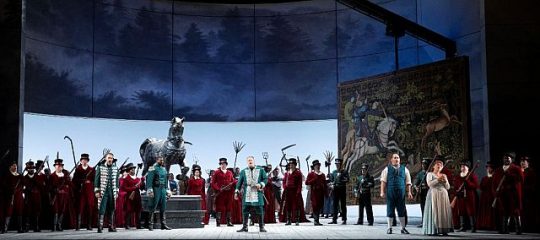
Luisa Miller at Lyric Opera of Chicago. (Todd Rosenberg photo)

4 stars

Love, lust, and quest for power lead to despair and death in Giuseppe Verdi’s “Luisa Miller,” directed by Francesca Zambello at Lyric Opera of Chicago.

The seemingly outlandish story based on the play “Kabale und Liebe” (Intrigue and Love) by Friedrich von Schiller, none-the-less may resonate with modern audiences familiar with such television programs as “American Greed” and “Dateline” that often have devious plots designed and perpetrated by individuals to preserve financial power or exert influence over those they purport to love.

In this case, Rudolfo (Joseph Calleja), the son of Count Walter (Christian Van Horn) falls in love with the peasant girl, Luisa Miller, (Krassimira Stoyanova). However, Count Walter’s aide-de-camp, Wurm, (Soloman Howard) also has designs on the local beauty resulting in love triangle number one.

Luisa’s father (Quinn Kelsey) feels there is something odd about Rudolfo who has been hanging around the village under the pseudo name Carlo.

Meanwhile, knowing that the Count was planning to wed his son to the local Duchess Federica (Alisa Kolosova) who has just inherited a fortune after her father’s death, tattletale Wurm tells Count Walter how Rudolfo has fallen in love with a common village girl.

The alliance between Rudolfo and Federica would increase the power and influence of the family, and secure his son’s future, resulting in love triangle number two.

The Count orders his son to marry Federica while Wurm imprisons Luisa’s fathe. Then coerces her into signing a declaration stating that she never loved Rudolfo but instead loves Wurm in order to gain her father’s release and save him from death.

In her despair, she begins to write a letter to Rudolfo suggesting that he meet her at midnight when the two will die together rather than submit to the unhappy fate that has been thrust upon them.

Finding the letter, Luisa’s father,  persuades her that in the morning the two of them will simply leave town together because the death of his daughter, and seemingly only offspring, would cause him too much anguish.

During the night while her father is asleep, Rudolfo comes to Luisa whom he tricks into drinking poison. He has taken it as well out of revenge for her recanting her love. Thus is the murder suicide that actually fulfills Luisa’s original plan for them.

The couple reconciles and Rudolfo manages to curse his father and mortally shoot Wurm before the poison takes its full effect.

There is little to say about the spectacular quality of the entire ensemble except to add that Stoyanova as Luisa delivers at every opportunity.

Perhaps part of the popularity of Verdi operas is that they are very accessible to the general public because the music is not overly complex. Though this opera does not have any of the popular famous arias such as “La donna e mobile” or “Celesta Aida,” it follows musical lines that are familiar to the ear.

If you are a lover of mid-century American musicals, I think you will find the structure of Verdi’s operas to have a familiar form.

Reflective of opera’s romantic period which introduces more theatricality into the productions, we can enjoy how the composer uses what have become traditional musical dynamics to convey the emotions of the characters in their over-the-top dramatic situations.

For the singers in this production, it is something of an athletic event as they have very little rest and are seemingly on stage all of the time. They are often performing complex imbroglios that at times seem akin to a wrestling match or singing competition.

It has been said that Verdi hoped to break out of the imposed traditional operatic format that for instance dictated that the production begin with a chorus number.

Interestingly, it was my impression that the opening of “Luisa Miller,” though entertaining and important in terms of setting the context and introducing the characters, has an obligatory quality that seems out of place when compared to the more intimate aspects of the rest of the production.

Perhaps, like the audiences in Verdi’s day, we might feel cheated if we did not have an opportunity to hear, in this case, the exceptional Lyric Chorus. They do appear again but actually each time it seems a bit out-of-step with the story.

Of course part of the reason to visit Lyric Opera Chicago is the opportunity to experience their fine orchestra conducted by Enrique Mazzola and led by Music Director Sir Andrew Davis. It is possible that the overture alone is worth the price of admission.

The scenery, painting, construction design and costumes used in this production are the property of the San Francisco Opera.

The primary scenic element, a large painting suspended from a crane in front of a curved panoramic modular background has an overall post-modern quality even though it is in a muted-toned, 19th century pastoral landscape style.

A standout for the costume department was a dramatic profusion of red riding apparel for the equestrian scene as well as the variation on a theme of green uniforms provided to the gentlemen of Count Walter’s court.

Details: “Luisa Miller” is at the Lyric Opera House, 20 N. Wacker Dr., Chicago through Oct.31, 2019. Running time is about 2 hours 45 minutes with one intermission. For tickets or other information call  (312) 827-5600 or visit  lyricopera.org/Luisa .

Reno Lovison

For more shows visit Theatre in Chicago