
A Christmas Carol is a joyful tradition

An older man in Victorian clothing and top hat stands in front of a holiday wreath with the text "Holiday Joy Past, Present, Future" on a snowy background.

Highly Recommended

Coca-Cola may have codified our image of Santa but Victorian author, Charles Dickens taught the world about the spirit of Christmas. The Goodman Theatre has continued that lesson in Chicago for 48 years.

Part of the success and charm of this tale is its simple elegance. The story is easy to understand even by the youngest theater goers yet it does not talk down the audience. It’s a kind of secular parable with a strong moral lesson to change your ways before it’s too late.

Originally published as a novella in 1843, it was first adapted for the stage just one year later by Edward Stirling. Subsequent adaptations, including this one by Tom Creamer, do not stray far from the source including much of Dickens’ own original dialogue.

The unique contribution of The Goodman tradition has been to broaden the universality of the message through colorblind, gender neutral and mixed ethnic casting as well as incorporating the use of American sign language. It provides a chance for virtually everyone to see themselves in the characters on stage while reminding us that we are all a part of a larger world.

The central character is Ebenezer Scrooge (Christopher Donahue), a wealthy businessman of advanced years whose name through his actions and discourse has become synonymous with self-centered miserliness.

When asked to donate to the less fortunate Scrooge asks, “Are there no prisons? … And the Union workhouses, are they still in operation?” When told many would rather die than have to go to the various institutions, Scrooge replies, “If they would rather die, they had better do it, and decrease the surplus population.”

Dickens teaches us, through Scrooge, about the spirit of Christmas quite literally using spectral visitations. The first is the deceased former business partner of Scrooge, Jacob Marley (Daniel Jose Molina). He reveals that Scrooge is to be visited by three additional ghosts representing present (Bethany Thomas), past (Lucky Stiff) and future (Molina).

In each subsequent period we experience the life and fate of Scrooge’s long-suffering clerk Bob Cratchit (Jon Hudson Odom) who has been sorely used by his employer yet somehow manages to retain an optimistic view and joyful demeanor.

We also get a glimpse into Scrooge’s own personal life including his relationship with his own family and past acquaintances.

In the end, Scrooge is confronted with his own fate and the potential fate of those whose lives he affects, most notably the Cratchit family including the ailing youngster, Tiny Tim (Ella Boparai).

I am a Dickens fan and have read most if not all of his popular works and seen many film and stage adaptations.  What I love about him is his attention to detail. He was a keen observer of people and the world around him.

He was a quintessential chronicler of the Victorian period and a champion of human rights that made a significant impact by drawing attention to the needs of the lower classes in England and particularly the needs of poor and neglected children.

As a reviewer I find it difficult to comment on the interpretation of the individual players in this production because Dickens does such a fine job of defining his characters that a capable actor need only crawl into the suit and perform what he is given.

That said, it certainly can be done badly but when done well, as is the case with this cast, what we see is the actor’s own humanity bleed through.

Donahue’s Scrooge is not like every other Scrooge I’ve seen nor is Odom’s Cratchit. Rather what I see are the aspects of Donahue’s own personality that is most like Scrooge and likewise Odom’s personal relationship with Cratchit.

I suppose this is what every modern actor is hoping to achieve. Whether Hamlet, Willie Loman or Scrooge these characters are so well crafted that they meld together with the actor and in turn with the audience because we see ourselves in each of these archetypes.

It’s easy to say that in today’s political and social climate this year’s version has particular significance but the genius of this story is that the social ills that confront us have been here for time immemorial.

However, Dickens reminds us that we do not have to change the world we only need to reach out to the persons closest to us to affect a modicum of change for them.

Holocaust survivor and author Elie Wiesel helped to popularize the Talmudic phrase, “Whoever saves one life, it is as if he has saved an entire world.” Matthew 25:40 quotes Jesus as saying, “Truly I tell you, whatever you did for one of the least of these brothers and sisters of mine, you did for me.”

A Christmas Carol is a familiar story to many who may have seen other stage versions or any of the popular movie versions including a number of modern adaptations and even animations.

For this reason, I consciously avoided The Goodman tradition for far too long, feeling I would rather not revisit this chestnut again. Well, I was wrong! The Goodman staging of A Christmas Carol is an exciting and satisfying visual extravaganza that incorporates all manner of stagecraft with technologies old and new, while retaining the essential aspects of the original.

In this way a modern audience will find what they desire while the purists (like me) will find their familiar favorite elements still intact. I guess I have discovered and transformed the Scrooge in me.

Marketing materials for various products often promise, “It will bring out the child in you.” This production absolutely does it. Likewise, it is indeed “fun for the whole family.”

Details: “A Christmas Carol” directed by Malkia Stampley is at The Goodman, 170 N. Dearborn Street, Chicago, IL through December 30, 2025. Runtime is about 2 ½ hours with one intermission. Visit goodmantheatre.org for tickets and information

Reviewer Reno Lovison

For more reviews visit Theatre in Chicago
Amadeus and the sin of envy

Ian Barford in Amadeus at Steppenwolf Theatre (Photo by Michael Brosilow)

Recommended

In Latin, Amadeus is translated as “love of God” or “beloved by God,” ascribed as a formalized derivation of famed composer Wolfgang Amadeus Mozart’s middle name.

“Amadeus” the play presented at Steppenwolf Theatre is a story of two men, one believed to be beloved by God and one who believed he could negotiate through prayer to win God’s love.

On the surface it is easy to assume this is a biographical sketch of Mozart. Indeed, the story written by Peter Shaffer does allude to the final years of the composer’s life. But actually, this is a story of one man’s envy of another man’s apparent God given talent.

Ian Barford lends his own exceptional skill to the character of Antonio Salieri, court music director in Vienna at the time of Mozart’s arrival in 1781.

The young composer moved to the city as a freelance musician, confident that his notoriety would provide access to influential members of society needed to build a career.

Winning the favor of Salieri along with Kapellmeister, Giuseppe Bonno (Robert Breuler), Baron Van Swieten (Yasen Peyankov) and Emperor Joseph II (Gregory Linington) would be essential to Mozart’s success.

Linington is perfectly imperious, adding a bit of comic relief as the regal dilatant whose enthusiastic passion is greater than his actual musical knowledge.

I enjoyed how periodically, the court entourage seamlessly slipped in French, German and Italian phrases and short conversations to display their global sophistication and secret plans; no doubt aided by dialect coach Kate DeVore.

The impertinent Mozart, brilliantly played here by David Darrow, is portrayed as an arrogant even silly manchild. It is revealed that the social and interpersonal skills of the former prodigy have been stunted by his overbearing father who managed his life up until this time. This has left the young man, now himself a father and husband, unable to manage his own affairs.

As a result, he is misguided by the scheming Salieri and allows others to easily take advantage of him, ultimately leaving him destitute, sick and dying at an early age.

His only solace is his nearly equally immature, devoted young wife, Costanze, tenderly played by Jaye Ladymore. She offers what she can to advance his career and encourage her genius husband. However, her “Wolfy” is consumed with his work and in desperate despair over their financial condition as well as his failing health.

Salieri’s appearance in the lifeline of Mozart is based loosely on an unsubstantiated myth that he poisoned Mozart resulting in his early death. It is suggested here however that, murderer, or not, Salieri may have been guilty of poisoning the young musician’s prospects for financial success.

Bradford does yeoman’s work providing the bulk of the heavy lifting in this production directed by Robert Falls.  It is essentially a long narrative from the point-of-view of Salieri delivered in a declarative as opposed to extemporaneous stye that leaves it sounding just bit “one note.”

Salieri is the important steady beat while Mozart is the melody that adds life to this theatrical composition.

Ora Jones and Sawyer Smith as Venticello I & II offer a kind of leitmotif, appearing and reappearing as spies and observers who whisper like a gentle wind in the ear of the envious Salieri.

The chorus of dignitaries as well as the citizens of Vienna (Andrés Enriquez, Jodi Gage, Michael Kingston, Aaron Kirby, Greg Komorowski, Matt Miles, Aja Singletary) are a generally quiet but powerful presence.

The costume design by Amanda Gladu featuring impeccable tailoring and luxurious fabrics, along with amazing hair and make-up, were extraordinary. With the exception of Mozart’s fuchsia tinted wig, I have to believe each person on stage could easily walk into any fashionable soirée in 18th century Austria without any suspicion that they were visiting from the future.

Scenic designer Todd Rosenthal met the challenge of this production in-the-round by cleverly utilizing the ceiling to affect a period atmosphere. It featured a lighted stained-glass inspired center panel that provided a point of focus to Salieri’s religious devotion.

Music is central to this story and the pre-produced performances of Mozart compositions augmented by original music by Mikhail Fiksel are supervised by Connor Wang. I could find no credit related to the performers responsible for the recordings. There are two surprising and delightful harpsicord numbers performed on stage by Barford and Darrow.

Mozart’s music is used fundamentally to expose Salieri’s self-loathing, allowing him to reflect on the young composer’s superior talent relative to his own perceived mediocrity.

It also serves to introduce the audience to the compositions Mozart created during this period of time, most notably, The Marriage of Figaro, Don Giovanni, The Magic Flute and his Requiem to which Salieri exclaims, “This will help the world to mourn for eternity. (approximate quote).

This is an interesting and entertaining approach to biography and history though certainly fanciful while retaining a number of essential truths.

The production will no doubt be of interest to lovers of classical music and music history buffs in general as well as those who enjoy a good theatrical tale well performed. There are some adult themes that may not be appropriate for all ages (I would say 15+ by today’s standards might be safe).

Details: Amadeus, is at Steppenwolf Theatre, 1650 N. Halsted Street, Chicago, IL through January 25, 2026. Run time is 2 hours and 45 minutes including one intermission. Visit Steppenwolf.com for tickets and information.

Reviewer : Reno Lovison

For more shows/reviews visit Theatre in Chicago

Much Ado at Chicago Shakes is worth the fuss.

Highly Recommended

Performed in modern dress using original Elizabethan vernacular, Much Ado About Nothing is a quintessential Shakespeare comedy that has a little something for everyone.  It’s a perfect show for groundlings who might appreciate that it is not too complex and at times borders on slapstick. It’s a humorous love story with a touch of drama that pokes fun at everyone no matter their rank.

The setting is the courtyard of the estate of the Governor of Messina, Leonato (Kevin Gudahl) where Prince Don Pedro (Debo Balogun) arrives with his crew, including his right-hand man Benedick (Mark Bedard) and fellow soldier Claudio (Samuel B. Jackson) who are greeted enthusiastically by Leonato’s daughter Hero (Mi Kang) and niece Beatrice (Deborah Hay).

Claudio is immediately smitten with the beautiful Hero and soon expresses, to his comrades, his desire to “take her to wife.” He is encouraged by the worldly-wise Don Pedro but utterly derided by Benedick who declares, “That a woman conceived me, I thank her; that she brought me up, I likewise give her most humble thanks…all women shall pardon me… [but]I will live a bachelor.”

Hero is likewise enamored of Claudio but like Benedic, Beatrice declares her desire to remain single saying, “I had rather hear my dog bark at a crow than a man swear he loves me.”

This sets up the dual love story whereby Hero and Claudio plan to wed while he, Don Pedro and Leonato conspire together with Hero’s maid Margaret (Tiffany Scott) and lady-in-waiting Ursula (Felicia Oduh) to set a trap that will unite the resistant Beatrice and Bendick. Hero says, “Some, Cupid kills with arrows, some with traps.”

In the meantime, Don Pedro’s bastard brother, the joyless Don John (Erik Hellman) plots with his accomplice Borachio (Yona Moises Olivares) aided by Conrade (Colin Huerta) to confound the marriage of Hero and Claudio – – primarily because in his own misery he can’t stand to see anyone happy.

Two men of the watch (Suzanne Hannau and Joey Chelius) charged with keeping the peace through the night inadvertently uncover Don John’s plot.

The hilariously bumbling constable Dogberry, (Sean Fortunato) laboriously explains the plot to Leonato through a series of malapropisms and confusions, ultimately driving the resolution of the tale with the aid of Leonato’s brother Antonio (Jeff Parker) and the friar (Jaylon Muchison) who manage a scheme to make all things right.

The simple elegant two-story courtyard set design by Tom Piper was very effective in providing a range of entry and exit points that kept the action interesting and surprising.

Directed by Selina Cadell, this was a very enjoyable performance where the players and the audience all seemed to be having a great time. The inclusion of a small ensemble of musicians added to the lightness of the production by interjecting some musical merriment between scenes.

Details: Much Ado About Nothing is presented by the Chicago Shakespeare Theater Company in their Courtyard Theater on Navy Pier, Chicago through December 21, 2025. Run time is about 2 hours and 25 minutes with one intermission. For ticket and information visit ChicagoShakes.com

Reviewer: Reno Lovison

For more shows visit Theatre In Chicago

Jekyll and Hyde Musical

Highly Recommended

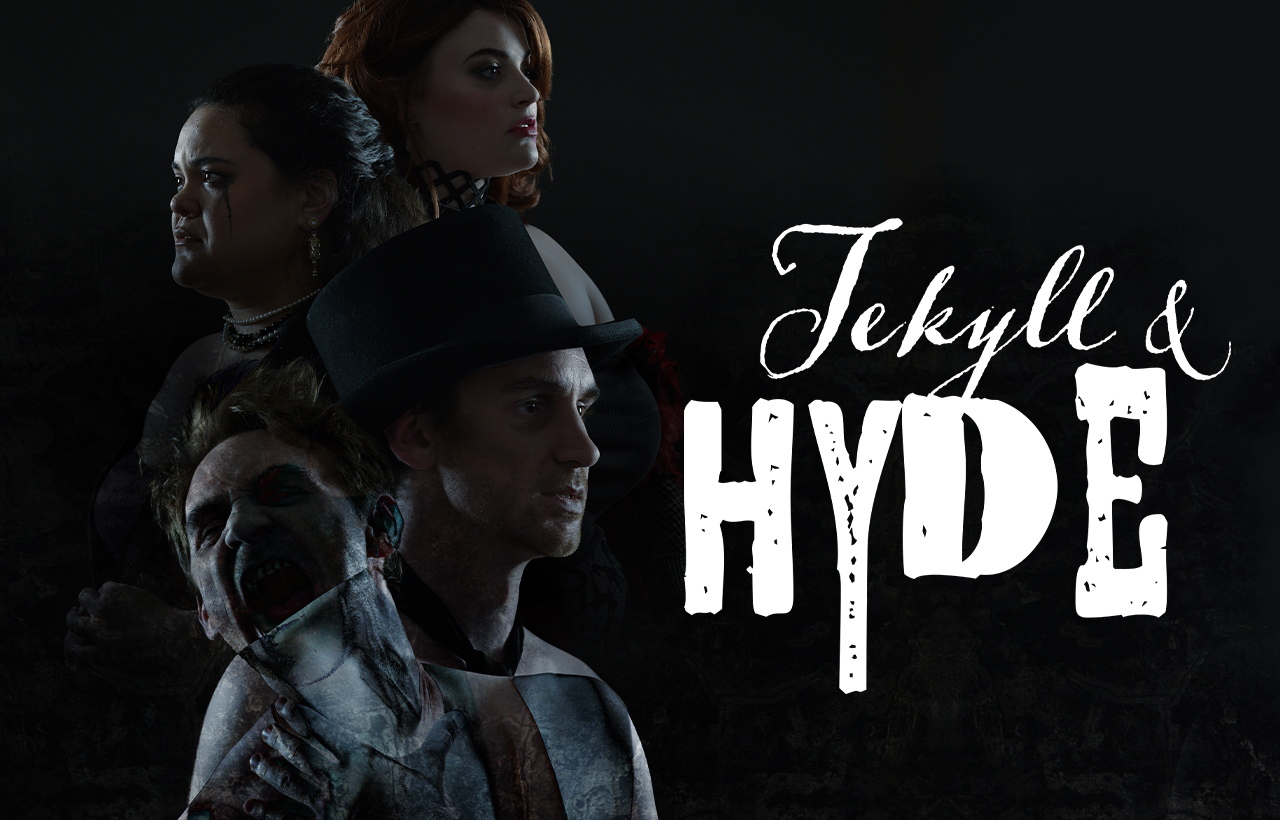
I have come a little late to this extraordinary musical retelling of Robert Louis Stevenson’s Jekyll and Hyde classic. Originally conceived for the stage in 1990 by Frank Wildhorn & Steve Cuden with music by Wildhorn and lyrics by Leslie Bricusse the show is presented here by Kokandy Productions.

For those unfamiliar with the 1886 original – – this is a tale of the strange case of Dr. Henry Jekyll, a fictional 19th century London physician who decides to experiment on himself using what might be described as psychotropic drugs.

His interest in the causes of insanity lead him to undertake this challenge in an effort to better understand the boundaries of the human mind, specifically as it relates to questions of morality. In doing so he unleashes his own demon in the person of his alter ego Mr. Hyde.

The early ensemble performance of “Façade” alludes to the multiplicity of human personality and the idea that we have to work to suppress our most base instincts while carefully crafting our public image.

In this production, both Jekyll and Hyde are expertly portrayed by soaring tenor, David Moreland who diligently adapts his voice and visage in a physically demanding transformation between each character as he struggles with the opposing forces of good and evil.

In deference to Victorian sensibilities, it would be unseemly for Dr. Jekyll’s fiancé Emma Carew (Emily McCormick) to have any interactions with the villainous Mr. Hyde who instead turns his amorous attentions to local sex worker Lucy Harris (Anna Seibert). These are not so much portrayals of good and evil but rather references to British upper- and lower-class social behavior. In fact, Lucy is quite kind and good but is easily abused by the sinister Hyde.

Baritone, Gabriel John Utterson (Kevin Webb) is Dr. Jekyll’s lawyer, and confidant who does his best to protect his friend.

The unchecked Hyde sets out to seek revenge by punishing the hospital board of advisors who were unwilling to support Dr. Jekyll’s initial request to experiment on inmates of the institution.

These members include the unsympathetic presiding officer Simon Stride (Quinn Kelch) whose bass-baritone had a particularly menacing timbre, Bishop of Basingstoke (Jon Parker Jackson), General Lord Glossop (Quinn Rigg) Lord Savage (Ismael Garcia), Sir Archibald Proops (Gabby Sauceda-Koziol), and Lady Beaconsfield (Maiko Terazawa) who gets a special mention for best hair and make-up.

Emma’s father, Sir Danvers Carew (Nathan Calaranan) is not exactly unsupportive but neither is he an enthusiastic ally of the doctor’s plan.

Quinn Simmons who appears as Jekyll’s butler Poole, as well as a number of other supporting characters, is one of those performers whose energetic presence is felt without being a distraction in spite of a gender bending persona that allows them to morph in a chameleon-like fashion from role to role.

In this performance understudy Seibert stepped in filling the role of Lucy (replacing Ava Stovall) providing a powerful solo delivery of “A New Life” as well as an exhilarating soprano duet of “In My Eyes” with Emily McCormick which nearly required a mid-play encore.

In general, the score by Wildhorn and Bricusse performed by an orchestra of 15 wonderful musicians led by talented music director Nick Sula, is an intense non-stop marathon of dynamic compositions seamlessly progressing from one to the other which had this very appreciative audience continually exhilarated.

It was clear that director Derek Van Barham had control of this company and a clear vision that was executed impeccably. This was in no small part augmented by the brilliant choreography of Brenda Didier with movements that effectively illustrated the various emotions and messaging required by each character or ensemble at any given moment.

The comparatively austere monochromatic wood grained multi-level set design of Sotirios Livaditis was very effective, offering a glimpse at the orchestra behind while providing vertical lift to the action.

The costumes of Rachel Sypniewski were perfection from head-to-toe including hair and wigs by Keith Ryan and make-up by Sid Genko complimented by lighting of “Max” Maxin.

Details: Jekyll & Hyde by Kokandy Productions is at Chopin Theatre, 1543 W. Division St., Chicago through December 21, 2025. Running time is 2 hours and 15 minutes with one intermission. For information and tickets visit kokandyproductions.com

Reviewer: Reno Lovison

For more shows visit Theatre in Chicago

Family history takes a strange twist


Miracle on South Division Street #2.JPG

Beverly, Jimmy, Clara and Ruth learn the truth about their statue.

Recommended

Nice image used for the play’s ad but wait until the end of the show at Citadel Theatre to decide who the statue is. Even the title is misleading.

The 90 minute show now on stage at the tiny but award-winning theatre in Lake Forest, IL, introduces audiences to the Nowaks of Buffalo, NY.

A close-knit family where mom, Clara (Naomi Hershman, a pious Catholic, two adult daughters, Beverly (Loreli Sturm) and Ruth, (Mindy Shore), and adult son, Jimmy, (Robert Wood Frank, live together, they are all on the edge of going in different directions partially because of a death-bed reveal.

The “kicker” comes near the end of the show when they learn the statue outside that was commissioned by their grandfather is not the Virgin Mary.

Directed by Scott Shallenbarger, the actors voices and actions may seem overblown but half an hour into the show, you get used to this family’s dynamics.

Written by Tom Dudzick (author of “Over the Tavern Trilogy”) the play’s timing fits right in with the spirit of the season.

DETAILS: “Miracle on south Division Street” is at Citadel Theatre, 300 S. Waukegan Rd., Lake Forest, IL, now through Dec. 14. 2025.

Jodie Jacobs

Theatre in Chicago


A fun evening out

Recommended

If you were lucky enough to experience the Chicago run of “Million Dollar Quartet” at the Apollo Theatre (a record breaker of Oct. 1, 2008 to Jan 17, 2016) you’ll understand why the concept of bringing back Memphis’ Sun
Studio stars Elvis Presley, Carl Perking, Johnny Cash and Jerry Lee Lewis for another jam session might make sense. The original book was by book by Colin Escott and Floyd Mutrux.

And if you appreciate Rock ‘n’ Roll you’ll likely enjoy an evening out with Marriott Theatre’s holiday reincarnation with its by book by Escott.

But the best reason to see “Million Dollar Quartet Christmas” at Marriott Theater is JP Coletta as Jerry Lee Lewis. Coletta, who has a long list of regional credits, embodies Jerry Lee’s  musical talent and oversized character as captured in the  original show.

Accompanying Coletta are Trever Lindly Craft as Carl Perkins, Michael D. Potter as Johnny Cash, Colton Sims as Elvis, and Teah Kian Mirabelli as Dyanne. Ross Griffin plays Sun owner Sam Phillips. In addition, Jed Feder is Flake and Cody Siragusa is Brother Jay.

This “Christmas” version is about 90 nonstop minutes of popular holiday and regional songs ranging from “O Christmas Tree” to “Go tell it on the mountain.”

DETAILS: Million Dollar Quartet Christmas” is at Marriott Theater, 10 Marriott Drive, Lincolnshire, IL. now through Jan. 4, 2026. For more information visit Million Dollar Quartet Christmas | Show

Jodie Jacobs

For more shows visit Theatre in Chicago

A Madkap Thriller


Michael Lomenick and Jeanne Dwan in “Deathtrap” at Madkap Productions

Ira Levin’s, circa 1978, now classic DEATHTRAP by Madkap Productions in Skokie, will ensnare you in a web of illusion and deceit with enough humor to take the edge off the murderous treachery taking place before your eyes.

The Sunday afternoon performance I attended was presented in front of a very appreciative packed house with only a handful of seats unoccupied.

Director Christa Retka did a commendable job orchestrating her team of five actors though this drawing room black comedy bordering on melodrama.

Michael Lomenick and Jeanne Dwan were perfectly believable as Sidney and Myra Bruhl a comfortable middle-aged couple who in the course of playful conversation find themselves plotting the murder of budding playwright Clifford Anderson (Beck Damron) in hopes of stealing his manuscript.

Famed psychic Helga Ten Dorp who has taken up temporary residence nearby has a premonition that threatens to expose the Bruhl’s plans.

The character of Helga is humorously played by BEKA who joins Madkap offering an expert performance after a seven-year hiatus from live theater while working on a number of Indie film projects.

Aidan Sternberg appears as the observant and attentive family attorney Porter Milgrim.

I’m reluctant to say more about the plotline as it has a number of surprises that border on genius.

This comedy-thriller is indeed “Madkap” fun employing startling special effects on a retro inspired set design by Brian Wasserman with lighting by Pat Henderson.

Details: “Deathtrap” by Madkap Productions is at Skokie Theatre, 7924 N. Lincoln Ave., Skokie, IL through November 23, 2025. For tickets visit SkokieTheatre.org or call 847-677-7761

Reviewer: Reno Lovison

For more shows visit Theatre in Chicago

A struggle to control destiny


HIGHLY RECOMMENDED

The House That Will Not Stand at Invictus Theatre Company is a compelling exposé of racism and misogyny representing several vertebrae in the backbone of our country. These are fundamental defects baked into the DNA of the nation with repercussions passed forward through generations.

Taking place in New Orleans circa 1813, the dialog skillfully explains that with statehood, the status of many free people of color and those of mixed-race heritage is going to change. Previous Spanish and French colonial laws were more liberal in regard to property rights, inheritance and manumission. Each of which are topics explored within this powerful production.

At the center is matriarch Beartrice Albans (Britt Edwards) the mixed race placée or concubine of the now deceased white patriarch, Lazare (Ron Quade) lying in repose on the dining room table.

In mourning are the couple’s three daughters Agnes (Kaylah Marie Crosby), Maude Lynn (Sierra Coachman) and Odette (Alysia Slade), also Beartrice’s troubled sister Marie Josephine (Jimiece Gilbert), as well as the matriarch’s visiting frenemy Madame La Veuve (Sandra Adjoumani) and including the household slave woman Makeda (Shenise Brown).

As the story unfolds, we learn that the family’s inheritance and the freedom of the women are at risk as a result of Lazare’s death.

Meanwhile, the young ladies yearn for more independence from their demanding and overbearing mother. They eventually conspire to sneak away to the upcoming ball where they might have the opportunity to meet a wealthy white man and affect a plaçage relationship that would provide for their future.

In the midst of their scheming, Agnes who is burning to find love, suggests that she will have the best chance of success because she is lighter skinned and therefore more desirable.

The beating heart at the core of the tale is Makeda, housekeeper, nanny and confident to all. She is practiced in voodoo but declares she only uses it for good and does not partake in the dark arts.

All of Makeda’s actions are focused on eventually obtaining freedom for herself as she performs a number of small favors to earn the money she will eventually need.

This is one of those rare theatrical productions where the entire cast is equally matched, each actor exhibiting the very highest level of skill and maturity. Shoutout to casting director Becca Holloway who obviously has an eye for talent.

To mention the performance of one actor over another is to do each a disservice, though Edwards as Beartrice has the last word in a short powerful energetically delivered summation monologue.

Those familiar with my reviews might have noticed I am quick to fault directors for many of a production’s shortcomings; but in this case I offer full compliments to Aaron Reese Boseman for pulling together one of the best ensembles I have seen in recent years.

This is an unusually lengthy production, in excess of two hours, but runs like a well-oiled machine. The extraordinary timing of the action did not rush nor did it linger.

The pacing felt like a symphony, partly due to the melodic cadence of the creole accents aided by dialect coach Susan Gosdick, while Ronald McDowell as Man with the Bamboula contributes periodic complex background rhythms from offstage reminiscent of not-to-distant African drums.

The stagecraft was exceptional including the blocking and delivery of each performance on the substantially imposing set design of Kevin Rolfs. This was augmented by the atmospheric lighting of Levi Wilkins including a substantial number of candles and lanterns that kept us solidly rooted in the time period, as did the costumes of Terri Devine with hair and makeup by Rueben Echoles.

Boseman’s steady hand, leadership and vision are obvious throughout the production.

There can be a tendency among some theater goers to feel that Off-Loop productions are not equal to their larger downtown cousins, but this production would certainly look perfectly comfortable on the Goodman, Steppenwolf or Shakespeare stages.

As a final personal note, I happened to have visited New Orleans a few weeks ago and in fact had partaken in a walking tour of the city’s history. So, I was really feeling the vibe and particularly enjoyed seeing many of the historical references I recently learned played out in context.

This story indeed deals with some dramatic and weighty subjects but the script by Marcus Gardley is not overbearing. If you are interested in seeing an enlightening historic drama well performed don’t miss this.

Details: The House That Will Not Stand at Invictus Theatre Company of Chicago, 3014 W. Irving Park Road, Chicago, IL plays through December 14, 2025. Running Time is 2 hours and 45 minutes with one 15-minute intermission. For tickets and more information visit invictustheaterco.com

Reno Lovison

For more shows visit Theatre in Chicago

Book of Will

Somewhat Recommended

We are all familiar with the existence of books entitled the complete works of William Shakespeare and may likely have heard of priceless editions of what is called the first folio recognized as being the first compilation of his works.

“The Book of Will” by Lauren Gunderson, currently  presented by Promethean Theatre Ensemble, is a fanciful, mostly humorous, fictional account of what it might have been like for Shakespeare’s friends and supporters to preserve his works for posterity.

The premise depends on the primary individuals who are referenced in the publication of the first folio. These include two fellow actors and longtime colleagues of Shakespeare, John Heminges (Jared Dennis) and Henry Condell (Ben Veatch). Both are credited with compiling and editing the plays for the Folio.

Also there are William Jaggard (Brendan Hutt) and Isaac Jaggard (Kevin Sheehan), the printers responsible for actually producing the physical book and playwright Ben Jonson (James Lewis), Shakespeare’s longtime friend and rival who wrote a dedication.

Hutt also plays Richard Burbage a celebrated actor of the time, considered to be a close collaborator of The Bard.

Another player is Ralph Crane (Jonathan Perkins) a professional scribe known for his role in transcribing and editing several of Shakespeare’s works. In addition, there are comedic roles enthusiastically played by Jesus Barajas.

This having been a largely male dominated society the ladies in this story operate primarily behind the scenes, principally in the persons of Rebecca Heminges (Anne Sheridan Smith) and Alice Heminges (Brittani Yawn) John’s wife and daughter respectively; as well as Elizabeth Condell (Sabine Wan) wife of Henry. The two wives and daughter provide insight and encouragement throughout the arduous process of identifying, procuring, editing, and producing the precious manuscript.

“The play’s the thing” and “this is the short and long of it . . . the web of [this play] is of a mingled yarn, good and ill together.”

To begin I found the script itself amusing and the premise thought provoking. After all, someone had to compile this evidently fragmented material in order for it to be bound for the benefit of future generations and I am glad of it. This accounting of what may have transpired is as good a guess as any.

Here’s where a few things went wrong. Most of the jokes are amusing but not really laugh-out-loud hysterical. The problem was a few members of the audience chose to issue loud guffaws or ear-splitting cackles. In this case it very nearly ruined the first half hour of the play for me but thankfully trailed off as the play progressed. I believe that I’ve noticed this to generally be a trend especially in smaller theaters lately and one that I hope will cease sometime soon.

The company decided not to try to perform this production with British accents which is fine, and each of the players did a fine job delivering their lines but, in many cases, there was an overall modern attitude to their delivery and comportment that I found mildly annoying within the context of this Elizabethan plotline.

“The purpose of playing… was and is, to hold as ’twere the mirror up to nature.”

Anne Sheridan Smith was the one who struck a tone and rhythm closest to what I would hope to hear. She seemed to do the best at internalizing the thoughts and feeling behind the words and speak them with heartfelt meaning. Brendan Hutt also had a theatrical comportment that seemed right for the material as did Jonathan Perkins as Crane.

I’m mixed on the performance of James Lewis as Jonson. When he recited Elizabethan texts, I could listen to his booming basso all day but the rest of his performance was too loose. I would think of Jonson as a drunkard perhaps but still a commanding person with inner dignity always working to maintain command of the stage.

The costumes of Rachel Sypniewski helped the overall atmosphere but I would like to have seen a few hats or caps especially on the men.

As they plot the folio project, Dennis and Veach have a lot of dialogue together which felt flat to me. But at some point, I closed my eyes to listen to them and realized that much of the issue came as a result of the awkward staging. It was all too static. They were often sitting bent over some papers at a small table stage left.

Likewise, Yawn as Alice was endlessly stuck behind an atrocious cube that served as the bar within the tavern where the action takes place. She had little stage business to occupy her and her relationship to the men at the table seemed distant.

The set design by Trevor Dotson was a complete miss for me. The bar is the focal point in the middle of the stage and it did nothing to add to the period décor. A piece of wood on two saw horses would have been better instead of what looked like a repurposed airport podium. The matching Formica credenza at the back must have come with it as part of an ensemble and was totally boring and out of place. Even a bit of foliage might have spruced it up. When it came to John and Rebecca’s pivotal bedroom scene it just looked like nobody cared and distracted from the moment.

The lighting of Jackson Mikkelsen could have helped more. I appreciated the few attempts at isolating the action but it needs to be amped up to be much more dramatic, especially in the bedroom scene and the following scene between John and Henry sitting on the floor. In both of these cases the mood would have been greatly enhanced by blacking out most of the set and isolating the duos.

I lay nearly all of my criticism at the foot of director Beth Wolf. Maybe the idea was, “we are not going to lean too heavily into the era.” Combined with everything I’ve said already, it just seemed haphazard.  The actors were fine and the script is good. She had the clay but sorry, it just did not come together for me as a polished production.

“Our revels now are ended. These our actors… were all spirits and are melted into air, into thin air.”

I loved the finale and am not unhappy as much as mildly disappointed. I wanted to love this. I did enjoy the story and some of the individual performances so for that reason say this is somewhat recommended.

DETAILS: “The Book of Will” by Promethean Theatre Ensemble is at the Den, 1331 N. Milwaukee, Chicago, IL through October 25, 2025. Running time is 2 hours with one intermission. For tickets and information visit thedentheatre.com or call 773-697-3830.

Reviewer: Reno Lovison

(ED note: Saw the American Players Theatre’s do this in Spring Green, WI a few years ago. The production was magnificent. So don’t write off this play by Lauren Gunderson. Just watch for it. JJ)

For More Shows visit Theatre in Chicago


Ashland Avenue at the Goodman is a humorous and poignant look at the end of an era.

A woman in winter clothes speaks to an older man behind a counter in a cluttered vintage store, with another man standing in the background.

(L-R) Jenna Fischer, Francis Guinan and Chiké Johnson. Photo by Todd Rosenberg.

Highly Recommended  

A dusty TV store onChicago’s Ashland Avenue is the flagging flagship of a once great regional empire that boasted multiple locations. During his tenure, owner Pete (Francis Guinan) became a local celebrity, famous for his “Crazy Pete” commercials. He is to be recognized with a citation from the mayor for his forty years of service to the business community.

The question becomes whether this publicity bump is truly the end of the road or does it signal the first step of a new journey.

Now in his early seventies Pete still has dreams and ambitions however, daughter Sam, played by Jenna Fischer (re Pam Beesly on the popular sitcom The Office), who has been by Pete’s side throughout her life is now ready for her own adventures with her husband, Mike (Chike Johnson).

On the surface, Pete’s once great empire has collapsed and he may not be as financially secure as he once was but his past accomplishments have value in the lives he has touched.

This play is certainly about Pete and his store but is also a subtle thesis on the rise and fall of America’s Main Street including the role retail has played as a community hub.

Open to all, small local shops have been proverbial gathering places were people assembled, sought refuge, traded, and enjoyed both incidental and meaningful encounters as is evidenced by Pete’s relationship with Jess (Cordelia Dewdney), a young woman and former employee who lives with Pete along with her two children.

The dialog is spectacularly natural and flowing with surgical precision to tell this slice-of-life tale. There is not one wasted word.

Playwright Lee Kirk seems to have insight or an uncanny ability to tap into the essence of Pete’s entrepreneurial spirit. This ability is reflected to some degree in Kirk’s film The Giant Mechanical Man which similarly explores the intersection of a person’s private and commercial persona. The film also stars Fischer which is where the two met. They were married in 2010 and have two children.

Susan V. Booth has done a wonderful job directing this production giving us a fly-on-the-wall view of the action taking place on the delightfully accurate set design of Kevin Depinet. It showcases a dizzying accretion of merchandise and promotional signage presumably assembled over four decades. The set is skillfully augmented by the lighting of Jason Lynch which includes multiple TV screens and store light fixtures.

The explosive appearance of Will Allan as Young Man cannot go unmentioned. Will demonstrates that there are no small parts. In his brief appearance he leaves it all on the stage thus providing an important and pivotal plot twist.

Ashland Avenue has all the best elements of a traditional stage play with a contemporary vibe.

Details: Ashland Avenue is at The Goodman, Albert Theatre, 170 N Dearborn Street, Chicago, IL through October 12, 2025. For tickets and information call (312) 443-3800 or visit goodmantheatre.org.

Reviewer: Reno Lovison