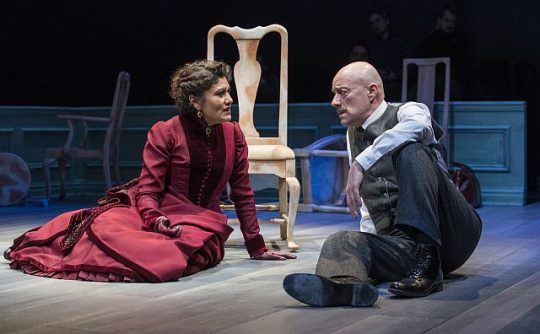
Sandra Marquez (Nora) and Yasen Payankov (Torvald) in A Doll’s House Part 2 at Stepponwolf Theatre. (Photos by Michael Brosilow)
3 1/2 stars
The back story is necessary to really understand playwright Lucas Hnath’s witty “A Doll’s House, Part 2, now at Steppenwolf Theatre. Otherwise audiences might sympathize with Hnath’s portrayal of the people Nora left behind when she slammed the door on her conventional, egotistical banker husband and their three children.
When Henrik Ibsen, a Norwegian playwright known for digging below society’s conventions to expose them for what they really are, published “A Doll’s House” in1879 he defied accepted familial and economic norms of the day.
He shocked a society that placed women in subservient roles to men. In many households, women were expected to be ornamental and needy and they had to have their husband’s or father’s signatures and OKs on legal documents.
Hnath, adept at penning plays that are both comedic and tense, (think Isaac’s Eye), takes on the “Doll’s House” iconic feminist heroine to ask how did she fare 15 years after she left her husband Torvald’s household and his demeaning view of her so she could be free to define herself.
Portrayed with gumption and defiance by Steppenwolf ensemble member Sandra Marquez, an extravagantly clothed Nora first challenges her old nanny, Anne Marie, to guess why she looks rich.
Played to perfection by Chicago veteran Barbara E. Robertson as the angry care-giver who stayed on to raise Nora’s three children, Anne Marie guesses traditional women tasks and skills. Continue reading “What if Ibsen’s Nora returned”
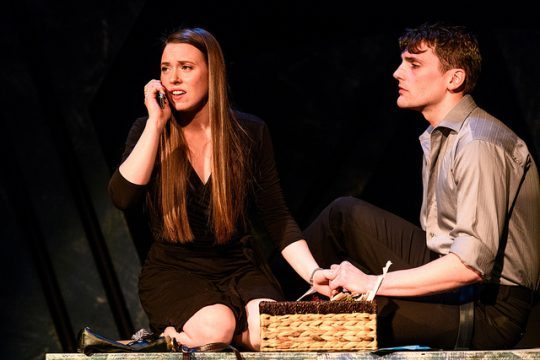
Cyndey Moody and Mike Newquist in Deadman’s Cell Phone at Greenhouse theater. (Photo by Paul Goyette
3 stars
Our cell phones have truly become extensions of ourselves, storing bits of personal and secret data with the potential to live-on sharing and connecting pieces of our lives even after we are gone.
In “Dead Man’s Cell Phone” presented by “The Comrades,” Wilmette playwright Sarah Ruhl explores what might happen when a stranger interacts with a deceased man’s cell phone she retrieves in a diner.
This is an absurd tongue-in-cheek noir-style, dark comedic drama directed by Arianna Soloway. It features the winsome, inquisitive and inventive Cydney Moody as “plain Jane” Jean who is perhaps being a bit voyeuristic but also just wants to make people feel better. In the process, she finds herself more involved than she probably expected.
Valeria Rosero and Cyndney Moody in Dead Man’s Cell Phone
Performed by an expert ensemble that includes Bryan Breau as the dead man Gordon, Caroline Dodge Latta as his at times overbearing but loving mother Mrs. Gottleib, Lynnette Li as his somewhat reluctant widow Hermia, Mike Newquist as his neglected brother Dwight and Valeria Rosero as the secretive “Other Woman.”
The stunning simple set design by Sydney Achler is a series of monochromatic paint-splattered trapezoids whose hectic colorization and odd angles contribute visually to the unbalanced surrealistic quality of the story.
There are a few bothersome inconsistencies in the story but they are easily overcome by the outstanding performances of the ensemble and the thought provoking subject matter.
This is a weird ride that makes you want to see what’s around the next turn.
“Dead Man’s Cell Phone,” The Comrades production at Greenhouse Theater Center, 2257 N. Lincoln Ave., Chicago, goes through March 10, 2019. Running time is 90 minutes with no intermission.For tickets and other information call (773) 404-7336 or visit Greenhouse Theater.
Philip Earl Johnson explains to Gwendolyn Whiteside how the deprogramming is going to work. (Photo by Michael Brosilow)
3.5 stars
“On Clover Road” keeps you on the edge of your seat.
It’s not often that a play comes around that creates such drama and suspense, your heart races and you might have to look away. Such is the case with the live performance of “On Clover Road,” playing at American Blues Theater through March 16, 2019.
The title itself implies a bit of luck that finding a four-leaf clover might bring. In a sense, the play is about luck too, both good and bad, and how it impacts the characters.
Written by Steven Dietz and directed by Halena Kays, “On Clover Road” tells the story of an angry, frustrated mother who meets with a cult de-programmer believing she will be reunited with her runaway daughter. Her daughter has been gone for more than four years and the mother has all but given up hope. Continue reading “Thriller on Clover Road”
Nina Stemme as Elektra at Lyric Opera of chicago. (Photo credit Cory Weaver and Lyric)
3 1/2 stars
A stormy Nina Stemme filled the Lyric Opera House with a powerful interpretation of Richard Strauss’ “Elektra,” Feb. 6.
Known to the Met and European house for her vibrant vocals in Wagner and Strauss operas the Swedish soprano is making her Lyric debut this month as the tragic Elektra whose only motive for living is to avenge the death of her father, Agamemnon.
Stemme not only brings the expected explosive passion to the role, she also tempers the portrayal with wistfulness and contemplative anguish.
A one-act opera, there are no gaps for well-deserved applause and bravo! after each of Stemme’s arias.
The other two important female roles are Elektra’s sister, Chrysothemis, sung beautifully by acclaimed South African soprano Elza Van Den Heever and their mother, Klyamnestra, expressively sung by internationally known American mezzo-soprano Michaela Matens.
The two male characters vital to the story, Elektra’s, long lost brother, Orest, and the queen’s lover, Aegisth, don’t appear until the end. Scottish bass-baritone Iain Patterson who was recently Creonte in Medea at the Berlin State Opera sounded right at home in this dark mythological tale as was American tenor Robert Brubaker, a frequent artist at the Met.
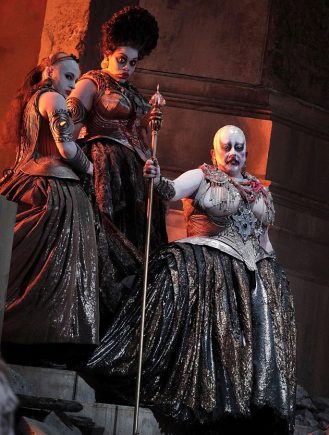
Michaela Martens as Klytamnestra with confidante Whitney Morrison and train bearer Emily Pogorelc in Elektra at Lyric Opera of Chicago (photo by Cory Weaver)
Directed by Nicolas Sandys as a revival of Director David McVicar’s production, the 2019 “Elektra” is not a stand and sing to the audience opera. Instead, it is dramatic theater that combines exceptional singing and acting with Strauss’ turbulent music played by the Lyric Opera Orchestra conducted by Donald Runnicles.
What audiences may not recall from this tale based on Sophocles’ Electra, is that the queen was enraged by Agamemnon’s supposedly appeasing a goddess by sacrificing another daughter, Iphigenia, before he left for Troy. But no matter the motivation, Greek mythology makes potent opera.
My only problem with the production was the costumes of Klyamnestra and her court. The rubble in and around the courtyard where the action takes place and the ruinous state of the palace, itself, seem to symbolize decay. I got that. However, the queen and her court appear to be over grotesquely costumed in apparel from a 1931 “Cabaret” nightmare so they distract from the opera’s action.
DETAILS: “Elektra” is at the Lyric Opera House, 20 N. WackerDrive, Chicago, through Feb. 22, 2019. Running time: 1 hr, 40 min. with no intermission. For tickets and other information visit Lyric Opera.
From left, Laurie Carter Rose (Robyn) and Ellen Phelps (Sharon) in The Roommate at Citadel Theatre. (Photo by North Shore Camera Club)
3 ½ starts
While watching the excellent portrayals of Ellen Phelps as Sharon and Laurie Carter Rose as Robyn, in Citadel Theatre’s “The Roommate, you may not agree with all their choices but you clearly get the message that they are seeking ways to begin their lives anew.
There are many quotable lines in this play by Jen Silverman, but one that delivers the show’s “raison d’etre,” is when Sharon says in Scene 2, “I guess everybody wants to start over. Just burn it all down and start over.”
A dark comedy, “The Roommate” brings together a recently divorced Iowan housewife searching for company and a way to split the bills and a lesbian, former Brooklyn con artist who really seems to want to escape her past in a small-town, farming community.
Their seemingly simple plans go awry as Sharon becomes interested in Robyn’s former life and Robyn realizes she may be a dangerously corrupting influence.
In addition, both women seem to have alienated their adult children. Neither Sharon’s son nor Robyn’s daughter want to call Mom until they realize through their parent’s strange, long distance calls that something is changing.
Even though I had seen the play and enjoyed it at Steppenwolf last year, I was appreciating the show once again until the last line which I objected to then and still do.
Depressed by her once again empty house because Robyn leaves, Sharon first says, “I don’t know where to start…. Except over again” Fine. The play should have ended there.
But then Sharon, handling some stuff Robyn left behind, adds what Robyn had said earlier in another context, “There is a great liberty in being BAD.”
Perceptively directed by Beth Wolf and staged on a believable, well-designed set by Eric Luchen, “The Roommate” offers a somewhat exaggerated but fun and interesting “what if” scenario on life when people reach middle age and wonder what should come next.
“The Roommate” is at Citadel Theatre, 300 S. Waukegan Rd., in a Lake Forest School District building, through March 3, 2019. Running time: 90 min., no intermission. For tickets and other information call (847) 735-8554, ext. 1 or visit Citadel Theatre.
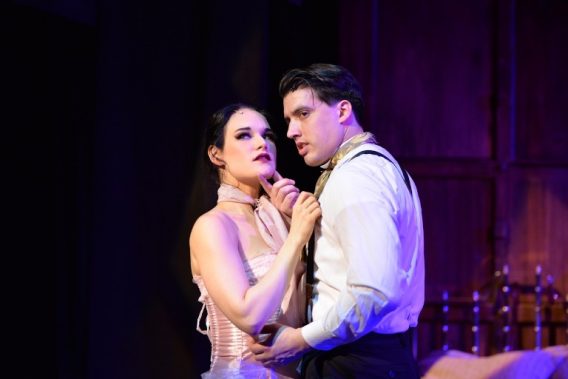
Emily Goldberg (Sibella Hallward) and Andres Enriquez (Monty Novarro) in A Gentleman’s Guide to Love and Murder. (Photo by Michael Courier)
3 ½ stars
Few plays open in song or in verse giving advice to the audience that if they are too weak to listen to a story of revenge and punishment, they’d better leave the theater.
However, it’s laughter that greets the Porchlight Music Theatre’s ensemble when they sing the warning to open the 2014 Tony Award-winning Best Musical “A Gentleman’s Guide to Love & Murder.”
Taking place in turn-of-the-century England, the “gentleman” is Monty Navarro played by Andres Enriquez. Monty is very poor, but Miss Shingle, played by Caron Buinis, helps him discover that he’s an heir to a fortune. Unfortunately, Monty is so far back in line he has to eliminate eight D’Ysquith relatives ahead of him.
Ayanna Bria Bakari (Natalie), Jasmine Bracey (G.K. Marche), Maya Vinice Prentiss (Riley) and Bernard Gilbert (Stokes) in the world premiere of How to Catch Creation. (Liz Lauren photos)
3 ½ stars
“How to Catch Creation,” a world premiere at Goodman Theatre, may sound like a how-to guide. But Christina Anderson’s new play is nothing like a step-by-step process.
Six people making up three intellectual couples search for fulfillment. Two couples are presented in the present in 2014. The third couple’s actions begin back in the 1960’s. But their lives are all presented at the same time, almost as two syncopated poetry readings.
During their journey of personal exploration they encounter snags of same and opposite gender attractions, divergent artistic paths and stereotypical thinking.
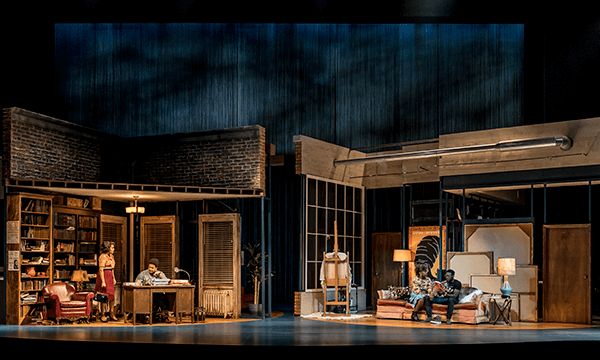
And it’s all done on scenic designer Todd Rosenthal’s stunning set. It revolves as two halves – one for the two contemporary couples, the other for most of the 1960’s situation.
The location is a California town similar to San Francisco and its area.
Sorry we’ve been asked not to reveal the plot’s unusual twists. What you would realize early into the show, is that all the characters are black and that Anderson deliberately presents the actions and dialogue from a black perspective.
But important as that perspective is, fulfillment desires and gender issues transcend race. Thus the play is meaningful on many levels. And under the direction of Niegel Smith who did “Father Comes home from the Wars” the cast superbly interprets Anderson’s sharp and clever dialogue.
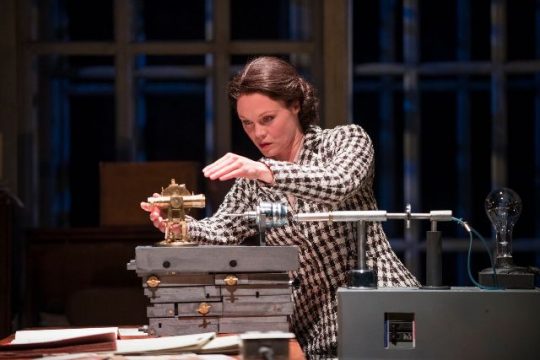
“Photograph 51” written by Anna Ziegler and Directed by Vanessa Stalling at the Court Theatre is a snapshot of the life of British chemist Rosalind Franklin (Chaon Cross).
Until recently she had gone virtually un-credited for her contribution to the discovery that revealed the structure of DNA to be a double helix. But the discovery earned her research colleague Maurice Wilkins (Nathan Hosner) and two rival collaborators James Watson (Alex Goodrich) and Francis Crick (Nicholas Harazin) the Nobel Prize.
Franklin was hired by King’s College London for her cutting edge expertise in the field of X-ray crystallography and assured that she would be in charge of her own research. Instead, she was assigned to Wilkins’ DNA project thus leaving her status of independence unresolved at best. Continue reading “‘Photograph 51’ is a portrait of life”
Maybe you knew that Dec. 24, 2018 was the 50th anniversary of Apollo 8, the first manned mission to the moon. Instead of watching the moon rise from earth, Apollo 8 astronauts Frank Borman, Jim Lovell and William Anders saw the earth rising from the lunar orbit, photographed it and did a live broadcast.
“The vast loneliness is awe-inspiring and it makes you realize just what you have back there on Earth,” Lovell said. It was Christmas Eve. The crew ended the broadcast reading from Genesis.
Almost 50 years from that memorable date, the Adler Planetarium’s own crew, that of astronomers and other staff members, were considering what they could do to not just mark the Apollo 8 crew’s occasion, which they did with a program that included Lovell, but also put it into perspective with a program that wasn’t just one day or week long.
The result is “Imagine the Moon,” a fun and exciting half-hour movie in the Grainger Sky Theater that includes Apollo 8’s earth-rising moments, the Apollo 11 landing with Neil Armstrong’s famed first words and a lot of literary and historic views of this orb that is Earth’s night light.
“We wanted the audience to reconsider the Moon as an object in the sky. It is something we might notice but not really pay attention to, but our hope is that the audience will pay attention to it the next time they see it, be awed by it, and be inspired to consider what else they might have taken for granted in the sky,” said Adler Presentation Leader, Nicholas Lake, the movie’s writer.
Among the interesting thoughts about the moon and even how to reach it that the show considers are mythological and early astronomical associations plus literary references and wishful attempts such as the use of a bullet and cannon.
Indeed, Jules Verne’s From the Earth to the Moon 1865 novel told of a Baltimore gun club’s idea to build a Columbiad space gun to send the club’s president and two others to the moon.
Beautifully illustrated, the show’s imagery was produced by Adler Director Patrick McPike and project animators using material from the Adler collection, the European Southern Observatory and such institutions as Harvard, New York University, and the Smithsonian.
So, go. Sit back in the theater as far as you can, look up and enjoy.
For ticket and other show information visit Adler Imagine the Moon or call (312) 922-7827. To see some of the stories in the show scroll down to exhibition.
The Adler Planetarium is at 1300 Lake Shore Drive at the far east end of the Museum Campus.
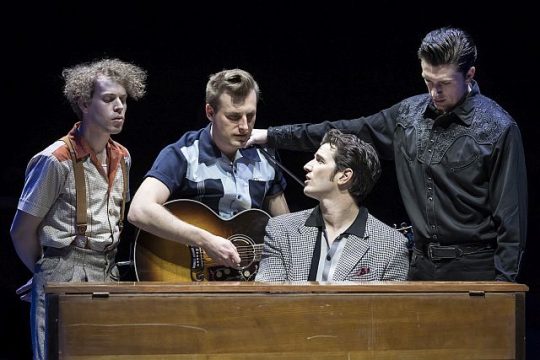
Nat Zegree, Shaun Whitley, Rustin Cole Sailors and Christopher J. Essex around the piano as in their characters’ pose in the famed Million dollar Quartet photo
4 stars
Going to Marriott Theatre for “Million Dollar Quartet” is like going to an amazing concert.
Some of the story-line is there on how and why future pianist extraordinaire Jerry Lee Lewis, the already famous Elvis Presley, the growingly popular Johnny Cash and the originator of “Blue Suede Shoes,” singer Carl Perkins, had all stopped by Sam Phillips’ Sun Records Memphis recording studio and service on the same December day in 1956.
But the reason to go to the show is to hear and see those four personalities come alive during an extraordinary 90 plus minutes jamming of “I Walk the Line,” “That’s All Right (Mama),” Who Do You Love,” “Great Balls of Fire” and their other hits.
The event, the only time these four future legendary entertainers were at the same place at the same moments, was captured by Phillips in a photo that would become famous. I saw it in the museum that is the Sun Records building in Memphis. The building is definitely worth a visit.
Phillips who became known as the “Father of Rock and Roll,” had recognized a future in syncing what was considered at the time to be “Negro” sounds and rhythms with other beats.
What the Marriott show doesn’t go into is the part radio personality Marion Keisker, a collaborator at Phillips’ Memphis Recording Service, played in bringing Elvis on board.
Originally conceived and directed by Floyd Mutrux with book by Colin Escott and Mutrux, the show is basically a jukebox musical. Premiered in Florida in 2006, it was produced in Chicago in 2008 first at Goodman Theatre and then moved to the Apollo Theater where it ran until fall 2014.
However, it does include short, spotlit, freeze points where Phillips interacts with each performer he developed while the other entertainers are in stop-action shadows.
It has Elvis accompanied by girlfriend Dyanne, portrayed with pizzazz by Laura Savage. She does a great “Fever” torch song during the jam session. As an aside, some stories about the event say he was accompanied by girlfriend Marilyn Evans.
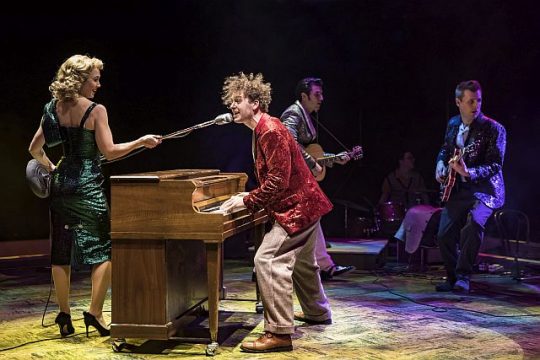
From L. Laura Savage, Nat Zegree, Rustin Cole Sailors and Christopher J. Essex in Million Dollar Quartet at Marriott Theatre Lincolnshire. (Photos by Liz Lauren)
What does matter is that the whole Marriott cast is terrific. Christopher J. Essex who has played the role elsewhere, really sounds like Johnny Cash. Rustin Cole Sailors who has been in several musicals on the West Coast does a fine Elvis impression. Shaun Whitley who reprises his Carl Perkins role during part of the Apollo Theater run has the perfect voice and plays a mean guitar.
But the person who usually makes this musical fun and exciting for me is the pianist portraying Jerry Lee Lewis. After more than 300 performances as Jerry Lee, as the famed entertainer is often called, Nat Zegree can not only play the piano with one hand, backwards, upside-down and certainly not sitting, but he can also do it blind-folded and does so during the encore.
Longtime actor David Folsom who has performed in shows from California to New York is a believable Sam Philips. Other important characters, although they are off to the side, are Zach Lentino reprising his role in the Apollo production as Jay Perkins, brother of Carl Perkins, on bass, and Kieran McCabe as drummer W.S. “Fluke” Holland which he has also played in other “Million Dollar” productions.
I also liked the use of the usually darkened, glassed-in room where Marriott Theatre’s musicians usually perform turned into Sun Records’ recording room.
Indeed, the entire staging was handled well. It felt as if we were all there at Sun Records.
So kudos to director James Moye, music director Ryan T. Nelson, set designer Jeffrey D. Kmiec, sound designer Robert E. Gilmartin and lighting designer Jesse Klug.
On the nit-picking side of what is otherwise a great show, I found the constant lighting up of cigarettes to be a distraction even though smoking was very popular mid last century. I also thought there were too many dead spots mixed in with Zegree’s rant about devil music. The other characters looked as though they were supposed to say something but didn’t and those time lapses were too long.
But the Marriott production is good enough to see more than once and share with friends.
DETAILS: “Million Dollar Quartet” is at Marriott Theatre, Ten Marriott Drive, Lincolnshire, IL through March 16, 2019. Running time: approximately 100 min. no intermission. For tickets and other information call (847) 634-0200 and visit Marriott Theatre.