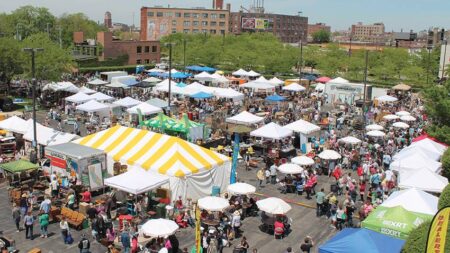
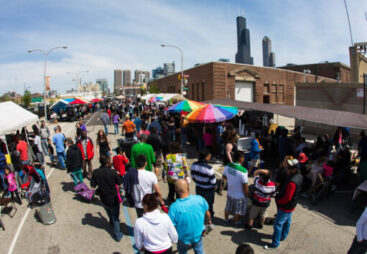
After a break due to COVID, Chicago’s famed Randolph Street Market Festival returns to the West Loop July 30-31, 2022, with booths full of well-curated, high-quality finds.
Open from 10 a.m. to 5 p.m. at the Plumbers Hall, 1341 W. Randolph, the market features one-of-a kind items from 175 independent vendors and designers.
Treasure seekers can expect to see vintage, antique and modern jewelry, art, fashion and home furnishings/decor.
Look for apparel and perfumes from Sugar Sequin Vintage, art and textiles from Global Attic & Naperville African Village, rock’n’roll and movie photos and posters at Atlantic Poster and vintage cowboy hats and paintings from Krava galleries.
In addition, find rare novels and interesting coffee table books at This Old Book, vintage French copper cookware at Challenge, mid-century modern goods at Tarkikngton antiques, vintage quilts at Spotted Horse Collectibles and Roodwood Pottery at Gin-For’s Oddities.
Among treats of the edible kind are lobster rolls from The Happy Lobster and gourmet cheesecake from Chicago Schweet Cheescake.
The Market can be reached through the Randolph Street and Washington Blvd Gate bordered by Ada Street on the east and Ogden Avenue on the west.
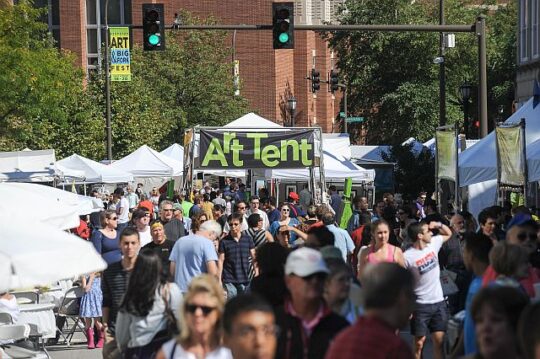
Art fairs are a chance to find a treasure and visit another neighborhood
The good news is that the Chicago area is filled with fun weekend outdoor events. The challenge is deciding what to fit in, how much to see (and eat), where to go, and when. Be adventurous. Instead of choosing just a local spot, add a place or event you haven’t tried.
Here are a half dozen events to check out in the rest of July 2022.
Stroll the downtown of this upscale North Shore suburb to see more than 90 artists and artisans. The show features ceramics, paintings, jewelry, sculpture, glass and wearable art. A kid-friendly and pet-friendly event, the show includes artist demonstrations, kids’ activities and live music.
Hours are 10 a.m. to 5 p.m. both Saturday and Sunday. The show’s center is 700 Vernon Ave., Glencoe. Free admission. For more information visit Amdur Productions/Glencoe.
Visit the downtown center of a former Naval Air Station in Glenview that was turned into a residential/shopping area known as The Glen. Operated by Art show guru Amy Amdur, Art at the Glen features the works of more than 140 artists.
The show is free. Hours are 10 a.m. to 5 p.m. Saturday and Sunday radiating out from 2030 Tower Drive, Glenview. For more information and a map see Amdur/The Glen.
The tiny (somewhat over a square mile) City of Highwood surrounded by the suburb of Highland Park, is known for the many restaurants that line its downtown on both sides of the METRA tracks. Those eateries, ranging from Italian and French to Caribbean and Asian will be ope but the featured foods this weekend are many kinds of tacos. The taco booths are in Everts Park, a block west of the train tracks and Green Bay Road between Highwood and North Avenues. Taco Fest hours: Thursday and Friday 5-11pm, Saturday noon – 11pm and Sunday noon – 9 pm.
The bonus for kids is a carnival set up in the METRA train lot on the east of the track. For more information and a map visit Taco Fest/Highwood Days.
Now in its 38th year and operated by the Wrightwood Neighborhood Assoc, the festival features restaurants in the area plus music and assorted vendors. Hours: Friday 3-10 p.m., Saturday and Sunday noon to 10 p.m. The event is on North Lincoln Avenue between Fullerton and Wrightwood.
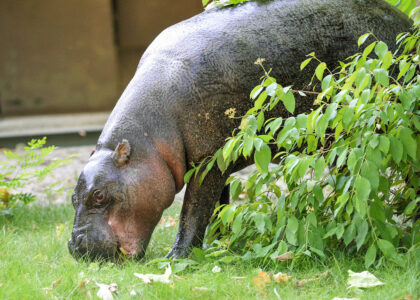
Pygmy hippo Banan. (Photo by Jim Schulz/CZS-Brookfield Zoo)
Meanwhile, in the southwest suburb of Brookfield, female pygmy hippopotamus Banana, is getting acclimated to her new home in Brookfield Zoo’s Pachyderm House and can sometimes be seen outdoors on that building’s west side. (Smaller than the river hippo, the pygmy weighs between 350 and 600 pounds and can grow to about 5.75 feet long,)
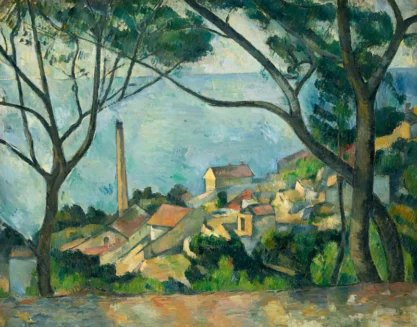
Paul Cezanne. The sea at L’Estaque behinf trees 1q78-79, Musee National Picasso-Pariss
Walking through Cezanne, an extensive exhibit now at the Art Institute of Chicago and co-curated with the Tate Modern in London, is like pulling back a curtain to really see and understand the French artist’s various approaches to portraitures, landscapes and figures.
Influenced by Camille Pissarro, Paul Cezanne (1839–1906) was also admired by Pissarro, Claude Monet, Henri Matisse and Pablo Picasso.
Indeed, “The Sea at L’Estaque Behind Trees” done by Cezanne, 1978-79 was owned by Picasso, and is in the Musee National Picasso-Paris collection on loan for this exhibit.
Works are on loan from several museums and private collections. Visitors should expect to spend close to two hours. The exhibit features 80 oil paintings, 40 watercolors and drawings and two sketchbooks. Some will look familiar. Others will be less known and seldom viewed.
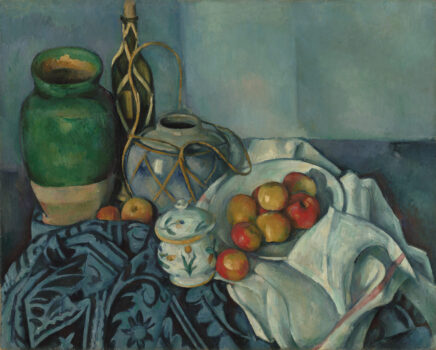
Still Life with Apples; Paul Cézanne (French, 1839 – 1906); 1893–1894; Oil on canvas; 65.4 × 81.6 cm (25 3/4 × 32 1/8 in.)
Beautifully curated, the exhibit places watercolors of the same or similar subjects close enough to compare. As with many artists, Cezanne’s works reflect different stages of life. Boards near each phase talk about those periods.
Called by some artists and art historians as the “Father of Post Impressionism,” Cezanne’s paintings are a bridge from Impressionism to Post Impressionism.
His early and middle years paintings also became his own bridge. Visitors who think they can identify a work as by Cezanne may be surprised . His “Still Life with Apples,” 1893-94 oil painting, is quite different from “Still Life with Knife and Watermelon” a watercolor done later, about 1900.
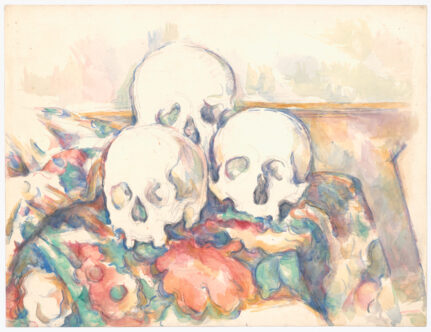
Cezanne’s still life paintings of apples and fruit could easily fill an exhibit on their own. But you will see a still life series of another subject, skulls. They were done in his later years.
Paul Cezanne. The Three Skulls, 1902–6. The Art Institute of Chicago, Olivia Shaler Swan Memorial Collection.
Part of his appeal to other artists was how his feelings about a subject were expressed by his brush strokes.
“Cezanne pursued an art distinct from his Impressionist colleagues,” explained Gloria Groom, Chair and David and Mary Winton Green Curator, Painting and Sculpture of Europe.
“Whether looking at the countryside around Paris or at a still life arrangement indoors, his was a laborious process and state of mind that involved finding the exact brushstroke to evoke his feelings, his sensations. The exhibition aims to deepen our understanding of this deliberate, singular process,” said Groom.
By the time a visitor exits the exhibit there should be a feeling that some paintings seen in art galleries and art shows in the current century are not that different in technique from how Cezanne painted.
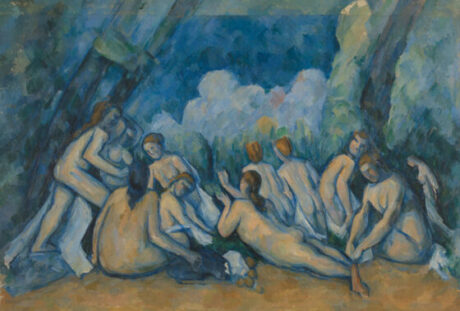
Paul Cezanne. Bathers (Les Grandes Baigneuses), about 1894–1905. The National Gallery, London (Photo courtesy Art Institute of Chicago)
“While Cezanne himself was as interested in long traditions of painting as much as its modernist future, it’s simply not possible to envision twentieth-century avant-garde art without Cezanne’s influence,” said Caitlin Haskell, Gary C. and Frances Comer Curator of Modern and Contemporary Art.
“Cezanne approached painting as a technically rigorous yet deeply personal search for truth in art making. And in the process he upended the conventions of artifice in European painting, laying bare the components of color and brushwork used to compose images, and establishing the fundamentals of what would become Cubism, Fauvism, and non-objective art,” said Haskell.
(Note: If you go, get the Art Institute app (know your Apple store password) and go to the number accompanying some of the paintings to hear about Cezanne’s technique and aims. The museum hasn’t been using individual recorded devices since COVID began.)
The exhibition is organized by the Art Institute of Chicago and Tate Modern, London. It is curated by Gloria Groom, Chair and David and Mary Winton Green Curator, Painting and Sculpture of Europe and Caitlin Haskell, Gary C. and Frances Comer Curator, Modern and Contemporary Art, Art Institute of Chicago and Natalia Sidlina, Curator, International Art, Tate Modern.
“Cezanne” is at the Art Institute of Chicago May 15 through Sept. 5, 2022. The museum has two entrances: 111 S Michigan Ave and 159 E. Monroe St. For more information including tickets and hours visit AIC.
Adler Planetarium is back open with new inter-active and reconfigured spaces. (Photo courtesy of Adler Planetarium)
Chicago and some area schools are on Spring Vacation through April 17. But even if your youngsters’ schools already had their break, terrific exhibits at Chicago’s museums are worth a weekend visit.
Fortunately, there are some free museums, free days and free to certain ages deals that can make a Spring Break outing less of a budget breaker. Most museum no longer require masks or vaccination proof but they do require advance tickets. However check the museum website for its current requirements.
For example of “free,” the National Museum of Mexican Art is always free. Located in the city’s Pilsen neighborhood at 1852 W. 19th St., the museum is currently featuring Freda Kahlo photos. But it is always filled with colorful and interesting galleries. Visit National Museum of Mexican Art for entry information. It is currently asking for masks and social distancing.
Also, the Illinois Holocaust Museum at 9603 Woods Dr., Skokie has a promo code “SPRING 22” that is good for free admission to children and students through April 17, 2022. The museum is also free to all the last Friday of each month.
Check out the following museums for more ideas and cost saving deals:
Chicago Museum Campus
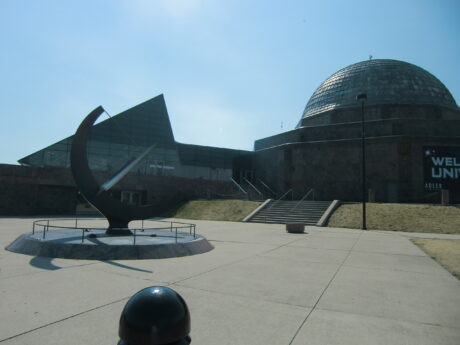
After closing for two years due to covid, the Adler Planetarium at 1300 S. DuSable Lake Shore Dr. at the east end of the Museum campus, recently reopened with more interactive exhibits and reconfigured spaces. The museum is free Wednesdays from 4 to 10 p.m. Among the fun, family-friendly spaces is the Clark Family Welcome Gallery with video presentations, interactive motion-sensing displays and pop-up exhibitions. Chicago’s Night Sky is also worth experiencing.
The Field Museum, at 1400 S. DuSable Lake Shore Dr. at the front end of the campus, has its free admission days May 14-15 and discounts the Discovery and all Access Pass those days so cost to Illinois residents would be $16 adult and $14 ages 3-11. Known for its dinosaur halls, The Field has gone further by going underwater to find giant species in its new temporary exhibit, Jurassic Oceans: Monsters of the Deep. Up through Sept, 5, 2022, this special exhibit needs a Discovery Pass or All Access Pass but there is plenty to see with General Admission.
Shedd Aquarium, at 1200 S. DuSable Lake Shore Dr., sits in the center of the Museum campus. The museum had free days earlier in the year but if living in Chicago find reduced fares through the Chicago Public Library: Kids Museum Passport.
Hyde Park Neighborhood
Museum of Science and Industry at 5700 S. DuSable Lake Shore Dr. has free days coming April 21 and 25 and May 2, 4, 9, 17 and 18. MSI, as the museum is usually known, can fill a day without its special exhibits but it currently has the blockbuster Art of the Brick, an amazing sculpture collection of LEGO Art that is up through Sept. 5, 2022. An extra ticket is needed but the display is worth the cost.
The DuSable Museum of African American History at 740 E. 56th PL, is celebrating 61 years as the country’s oldest independent African American Museum currently has free admission for all every Wednesday. Masks are required for ages 5 and older. Among the exhibits are “Freedom: Origin and Journey” which looks at several key periods in African American history and South Side Stories such as “The Art and Influence of Dr. Margaret T. Burroughs, 1960–1980.” It looks at Burroughs’s “legacy as an artist, creator, activist and institution builder.”
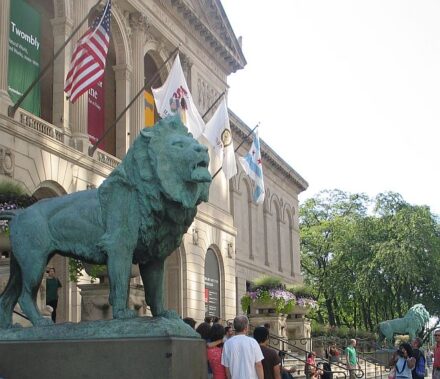
Art Institute of Chicago main entrance. (Photo by J Jacobs)
Art Museums
Art Institute of Chicago, has a main entrances at 111 S. Michigan Ave. and around the corner at 159 W. Monroe St. to its Modern Wing (connected to the main building). It is free to Chicago teens under 18 and all youngsters under 14. Frequent AIC visitors have favorite galleries such as French Renaissance and the Thorne Rooms (miniature periods). The current exhibit is “Life and Afterlife in Egypt,” an impressive, recently re-done permanent display of items already held by the museum.
Museum of Contemporary Art, 220 E. Chicago Ave. is free to visitors under age 18 and Illinois residents receive free admission every Tuesday. Visitors who enjoy debating what is art and what does it illustrate should see “Based on a True Story.” Using items mostly owned by the museum, it puts together the works of 20 artists who “play with fact, fiction, and the grey areas between” that “wrestle with truth and belief by exploring fiction.”
Lincoln Park Neighborhood
Chicago History Museum at 1601 N. Clark St. is on the edge of the park. Check out its “Crossroads of America” which includes stepping aboard a fancy, old train car. Also up is an exhibit of women’s voting struggles and items from the museum’s Costume Collection. The museum is free is Illinois teens under age 18 and all children under age 12.
Peggy Notebaert Nature Museum at 2430 N. Cannon Dr., is a Chicago Academy of Sciences museum that is also on the edge of the park. Come here to see, walk among and learn about butterflies. Exhibits also include climate change, weather and rivers.
Avec River North, a popular upscale restaurant, is participating in Chicago Restaurant Week. (Photo courtesy of Avec River North)
After surviving a winter of ordering out and shopping and seeing shows virtually, it’s nice to find a few fun, in-person options filling the April calendar.
Chicago Restaurant Week
Now through April 10, diners have a chance to try a new on the city’s food scene or popular but pricey upscale eatery at a more pocket-friendly level.
Menus are multi-course, prix fixe at $25 for lunch or brunch and $29 and/or $55 for dinner. Experience can be dine-in or takeout/delivery. (Price excludes beverages, tax, gratuity, and delivery fees). Find restaurants and menus at Chicago Restaurant Week Participating Restaurants | Choose Chicago
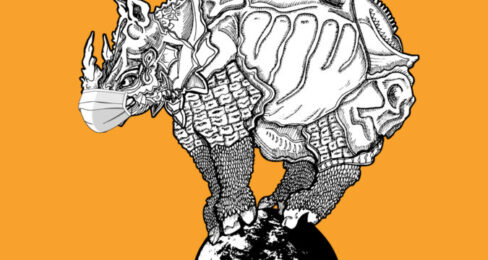
Rhino Fest returns in April 2022 (Photo courtesy of Pride Arts)
Pride Arts and Rhinofest
After missing 2021 due to COVID, Hint of Rhino: Rhinoceros Theater Festival 2022 , will be April 1 through May 7, 2022. Presented by The Curious Theatre Branch in association with the Pride Arts Center and Jimmy Beans Cabaret, Prop Thtr and Labyrinth Arts, shows will run Thursday through Sunday at Jimmy Beans Coffee (2553 W. Fullerton Ave, second floor) in Logan Square and at the Broadway Theater at Pride Arts Center (4139 N Broadway Ave) in Uptown.
Tickets to all events are $20 or pay-what-you-can. Proof of vaccination will be required at the door, and audience members and crew will remain masked inside venues. For ticket, show and other information visit rhinofest.com.
Maxwell Street Market
Known for its crafts, clothes, music, street food and family fun, the historic Maxwell Street Market reopens April 3. Hours are Sundays from 9 a.m. to 3 p.m. For directions and more information visit City of Chicago :: Maxwell Street Market.
Maxwell Street Market reopens. (Photo courtesy of City of Chicago)
Expo Chicago
Among the world’s leading art exhibition and programing, Expo Chicago will be at Navy Pier April 7 through April 10, 2022.
Coming in the second half of April, the Latino film Fest runs April 21 through May 1, 2022. For locations and more information visit CLFF – Chicago Latino Film Festival.
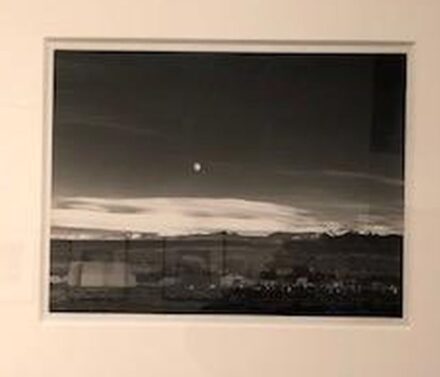
Ansel Adams, “Moonrise” can be seen at the Lake County Forest P:reserves’ Dunn Museum in Libertyville, now through March 27, 2022.
Many admirers of the art of photography are familiar with Ansel Adams’ remarkable shots of the US western landscape taken in the 1970s. Arguably less known or viewed in an exhibition are Adams’ prints from the 1920 through the 1950s.
Now, “Ansel Adams: Early Works” a traveling exhibit organized by art2artCirculating Exhibitions, LLC, and sponsored at the Bess Bower Dunn Museum by the Lake County Forest Preserves’ Preservation Foundation and Dan and Shirley Mayworm, opens a portal to the famed photographer’s interests, artistic development and his thoughts on his objectives. The works are from the collection of Michael Matts and Judith Hockberg.
Wander through the Dunn Museum, worth a trip on its own for its early Illinois history and objects, to see “Moonrise” which proved, as a video in the exhibit explains, that some, great photography moments are unplanned.
Read the plaques that accompany the exhibit for insight into some of Adams’ observations of photography’s power. Going through the exhibit then retracing ones steps brings out changes in his artistic and unique view of nature.
One plaque reads: “When I first made snapshots in and around Yosemite, I was casually making a visual diary – recording where I had been and what I had seen – and becoming intimate with the spirit of wild places. Gradually my photographs began to mean something in themselves; they became records of experiences as well as of places. People responded to them, and my interest in the creative potential of photography grew apace.”
The show’s prints are part of Adams’ photo output. But to better understand the photographer don’t miss the plaques next to some of the photos. This one is next to Mount Brewer, Circa 1925, a vintage gelatin silver print.
“When I first made snapshots in and around Yosemite, I was casually making a visual diary – recording where I had been and what I had seen – and becoming intimate with the spirit of wild places. Gradually my photographs began to mean something in themselves; they became records of experiences as well as of places. People responded to them, and my interest in the creative potential of photography grew apace.”
Another plaque says that trees are not just trees. Look for a photo where the forest looks lacy then look for “Aspens” that is a study in design and contrast.
Dan Mayworm who worked with Adams for a few weeks includes some pointers in the exhibit that he gleaned from Adams including “Expose for the shadows and develop for the highlights.”
“Ansel Adams: Early works is at the Bess Bower Dunn Museum of the Lake County Forest Preserves, 1899 W. Winchester Rd., Libertyville, IL from Nov. 6, 2021 through March 27, 2022.
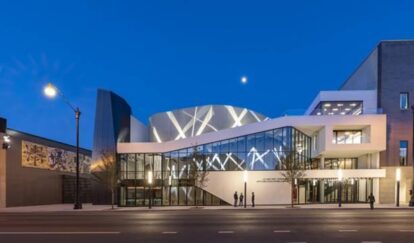
The Liz and Eric Lefkofsky Arts and Education Center. (Steppenwolf Theatre Company photo)
Internationally known Steppenwolf Theatre Company finally appears settled. Today, Nov. 2, 2021, Steppenwolf announced its $54 million Liz and Eric Lefkofsky Arts and Education Center is now open.
Once a small ensemble begun in 1974 by Terry Kinney, Jeff Perry and Gary Sinise, it opened in the Unitarian Church in Deerfield, moved to the basement of another church in Highland Park, later on found a space at the Hull House on Broadway in Chicago, then an intimate space on North Halsted before settling into the 1600-1700 block of North Halsted in the Lincoln Park neighborhood. Along the way it added H. E. Baccus, Nancy Evans, Moira Harris, John Malkovich, Laurie Metcalf and Alan Wilder and other well-known actors to its ensemble roster.
Part of a multi-phase $73 million Building on Excellence expansion campaign, the Liz and Eric Lefkofsky Arts and Education Center houses a 50,000 square foot theater building plus education center designed by Gordon Gill of Adran smith and Gordon Gill Architecture with theater design and accoustics by charcoalblue (construction is by Norcon).
Steppenwolf’s expanded campus includes, new lobbies, full-service bars and The Loft Space for area youth.
“What an extraordinary day this is for our company and Chicago. This multi-phase campus expansion is over two decades in the making and is a manifestation of Steppenwolf’s core values of ensemble, innovation and cultural citizenship,” said Executive Director E. Brooke Flanagan.
“Formed by an ensemble of young actors who wanted to create courageous work, nearly 50 years later our expanded campus builds on the company’s beginnings and ensures a future for the continued artistic growth of the ensemble and space for tens of thousands of Chicagoland teens to experience transformative arts education,” Flanagan said.
For more information about Steppenwolf Theatre Company visit Steppenwolf.
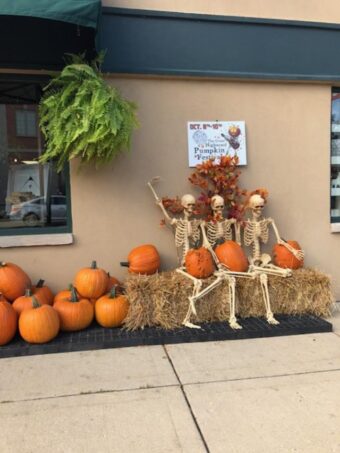
Pumpkins and skeletons and lining up in Highwood for the Great Pumpkin Fest ( J jacobs photo)
From the city and Oak Park to Glencoe and Highwood, there are events worth posting on the calendar.
Highwood
In the past few years with the exception of COVID 2020 tiny, north suburban Highwood has been trying for a Guinness record of carved pumpkins. But what area residents and visitors like is that the town’s Great Highwood Pumpkinn Fest includes music, a charity run, food, games and rides.
The event opens Oct. 7 with pumpkin carving and music, then continues, Oct. 8-10 from 9 a.m. to 11 p.m. This year, it also includes free COVI D testing. Check the schedule for specific event times and ride cost.
Highwood snuggles east of Highland Park along Waukegan Avenue, Green Bay Road and Sheridan Road.
Glencoe
Merely strolling among trees, water features and gardens at the Chicago Botanic Garden is worth the trip. However, CBG also holds the Night of 1000 Jack O’ Lanterns Oct. 13-17 and Oct. 20-24 from 6:30 to 10:30 p.m. Creative faces may spark ideas for home carving and are a terrific photo op (selfie?) Find more information at Chicago Botanic Garden
Chicago Botanic Garden is just east of Edens Expressway at 1000 Lake Cook Road, Glencoe.
Wilmette
Chalet Nursery’s Scarecrow Making is sold out its garden is stacked with pumpkins, corn stalks and other decorations for October and Halloween. Plus it has some fun selfie areas.\
It’s events calendar includes the movie “Haunted Mansion” shown outside Oct 14 at 6:30 p.m. Registration needed and a “Howl-O Ween” Pet Parade, Oct. 31 from 11 a.m. to noon.
Chalet Nursery is at 3132 Lake Ave., Wilmette. Visit Events – Chalet Nursery for more information.
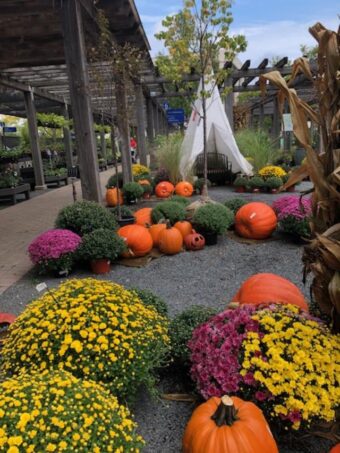
Chalet Nursery decorates for fall. (J Jacobs photo)
Oak Park
Poe’s dark side is perfect for the season. The Oak Park Park Theatre Festival brings “The Madness of Edgar Allan P:oe: A Love Story” to the Pleasant Home Foundation Oct. 15-Nov. 7, 2021. where audiences can move from room to room for different scenes.
Pleasant Home is at 217 Home Avenue, Oak Park.For tickets and more information visit Oak Park Theatre Festival
Lisle
Fall is a great time to drive through the Morton Arboretum but there is also something doing among the trees for walkers. The Arboretum has “Walking Plays” of popular fairy tales. Oct. 15-Nov. 7, 2021. Tales area abut 90 minutes and walks are less than two miles. To sign up and find more information visit Walking Plays/MortonArboretum.
Chicago
The whole city is open virtually in October through a Chicago Architecture Center app during Open House Chicago. There are trails, neighborhoods and treasures to explore. To see some of it in person, go Oct. 16-17. Registration needed. Visit Open house Chicago.
McCormick Bridgehouse and River Museum (Photo by Eric Allix Rogers for Open House Chicago and Chicago Architecture Center
From the Obamas in Hyde Park and the trail of the Great Chicago Fire noted on its 150th anniversary to the little known River Museum and McCormick Bridgehouse at Michigan Avenue and the Chicago River, Chicago has so many interesting places to visit, inside and out, that it would take the old saying of “a month of Sundays” to explore them. Fortunately there is Open House Chicago .
Organized and hosted by the Chicago Architecture Center every October, OHC used a mobile app App · Open House Chicago for virtual explorations in 2020.
It will be available in an expanded virtual version (updated Oct 1) to include neighborhoods for 2021 and run from Oct. 1 through Oct. 31. There will also be in-person visits Oct. 16-17, 2021. That will include behind-the-scenes visits and access to more than 100 venues in 30 Chicago neighborhoods and some suburbs
OHC is a free public event. However, there are a couple of special fee programs open to the public for a fee (waived for members of the Chicago Architecture center). Registration and tickets are required for programs and some visits. Previews on September 28 and 29.